CWC PRIMER Chapter Two:
Means of Chronological Dating
The distinction between
history and prehistory is elementary -- the presence or absence of contemporary
historical texts capable of relating past human experience. This having been said,
things quickly grow complicated. The entire process of determining the cultural
attributes of past civilizations requires the use of a complex array of tools
combining archaeological with historical and literary means of investigation.
Three things need to be discussed in this chapter, each related to determining
historical chronology -- archaeology, forms of writing, and the value of each
to historical analysis.
1. Archaeological Means
of Dating
Archaeological
investigation relies on the survival of material remains to date phases of past
human existence and to identify the attributes of ancient cultures. Since the
last mentioned form the building blocks to civilization, and in particular to
the chronologies of the materials to be presented in these pages, it is best to
achieve some basic understanding of archaeological strategies and vocabulary.
Moving from the remote to
the specific the first challenge for archaeologists is to identify the location
of past human remains. Ruins of ancient cities in currently populated areas may
seem relatively obvious places to start, not to mention cities such as Athens,
Rome or Istanbul (Constantinople) that remain inhabited continuously since
antiquity (and hence reveal ancient remains whenever one excavates a foundation,
a pipeline or a subway). What about abandoned settlements in less well
populated regions, particularly those inhabited by past elements of rural or
pastoral populations? Archaeological investigation of famous ancient cities
such as
Fortunately, archaeological
investigation elsewhere in the Mediterranean and the globe continues at an
unprecedented pace, with more than 300 active archaeological projects in modern
One of the tactics used
increasingly to locate archaeological remains, Remote Sensing (analysis
of satellite imagery and aerial photography of land surfaces from above),
enables researchers in well exposed areas such as deserts and treeless plains
to identify archaeological features on the land surface. These include the
remains of Roman army camps, ancient road networks, and the seriation of
ancient farm land into individual land allotments -- all easily detectable from
space under suitable conditions. However, the most reliable way to locate
archaeological remains is Pedestrian
Field Survey, that is, the mapping of surface remains by teams of walkers
using systematic procedures. In general, systematic field walking enables investigators
to identify areas of human land use, but it is restricted in its accuracy or
completeness by the happenstance character of that which survives on the
surface as well as by the "resolution" of the methods used to locate
and record surface remains. Field survey holds the advantage of investigating
archaeological terrain in spatial terms; it enables archaeologists to
reconstruct lines of communication between urban centers and rural hinterland,
to identify settlement patterns, and to delineate the process of transition in
human occupation over time.
Once investigators have
identified a worthy "site" for intensive investigation and preferably
have located optimum areas for excavation through use of ground penetrating
radar, electrical resistivity, or magnetonomy (all of
which employ geophysical analysis of subterranean "anomalies" to
identify building remains), they resort to Field
Excavation to unearth buried remains. Given the extremely high cost of a
properly conducted excavation program and the need to obtain scientifically
viable results at all events, a number of preliminary questions are usually
raised. For example, why excavate one particular site as opposed to another in
the same vicinity? What does one expect to learn from that excavation that
cannot be learned elsewhere or by other, less expensive means? An array of
models or hypotheses intended to guide any scientific archaeological
investigation and to gauge its results become mandatory. Typically, researchers
devise a project that combines social theory (high level theory) with suitable
methodology (base line theory) to arrive at anticipated results (mid-range
theory). Once these overriding questions are satisfied, excavation offers the
best means to investigate remains in undisturbed, "closed contexts"
and the potential to furnish a more detailed record of past human existence. It
needs to be borne in mind that most abandoned ancient settlements were stripped
of anything of value by contemporary looters, including wooden door jambs and
window frames, leaving behind little more than wall rubble and ceramic debris.
Given the pain-staking labor required to remove quantities of heavy earth
(carefully recorded centimeter by centimeter), to expose valuable antiquities,
and to preserve and/or restore them, excavation procedures are inherently
expensive, time consuming, and (by digging down through one context to another)
destructive. From a scientific standpoint excavation remains essential to
obtain chronologically accurate data for cultural remains.
Archaeological remains
whether investigated by means of survey or excavation tend to be organized
according to two basic types: artifacts and features. Artifacts are
defined as movable objects fashioned by humans. Typically surviving artifacts
represent tools and furnishings fashioned from stone, bone, clay, glass, wood,
textile, or metal. It is important to note that organic remains such as human
tissue, textiles and wood tend to decompose rapidly and rarely survive in the
archaeological record, bone and teeth being exceptions. From an organic
standpoint, however, laboratory analysis has expanded the range of
archaeological investigation to microscopic levels, opening new avenues of
investigation such as analysis of food residue that survives on the interior
surfaces of ceramic plates and bowls (paleoethnobotany), analysis of
microscopic particles of 'petrified' plant tissue of organic materials utilized
by humans, including lignin (wood tissue; and phytoliths - biogeoarchaeology,
macrobotany, etc.), and most particularly analysis of
human and animal DNA obtained from bone and skeletal remains preserved in
archaeological contexts. The significant breakthroughs furnished for prehistory
by DNA research will be highlighted in the following chapter.
A second type of
archaeological remains is referred to as Features, or immovable remains.
These include built environments such as monumental public buildings
(porticoes, temples, council houses, city walls), domestic or utilitarian
architecture (houses and storage facilities), and agricultural and artisanal
features such as ceramic production kilns, wine and oil press installations,
charcoal production sites, metallurgical workshops, and even threshing floors.
Depending on the extent to which these remains survive on the landscape
investigators use them to reconstruct some semblance of a culture's pattern of
existence. Careful isolation and identification of correlative artifacts and
features are said to form an Assemblage of a given human settlement in
time. Assemblages need to be carefully identified in controlled contexts to
insure that their components are in fact coeval. The most certain way to do
this is through carefully observed and recorded excavation (see below).
Individual cultures tend to
leave the same characteristic assemblages wherever they settle, particularly in
the form of tombs, build environments, and fashioned tools. Similarly as
populations expanded, elements of the same culture carried their attributes
with them leaving behind patterns of common assemblages across the landscape.
The identification of a pattern of assemblages spatially and temporally
indicates the existence of a wider culture. Some cultures buried their dead in
earthen mounds, for example, others cremated their dead and interred the
remains in clay vessels, others still exposed their dead on high platforms to
be consumed by scavenger birds. How people worshiped, how they buried their
dead, how they organized their settlements, how they prepared their food, even
how they fashioned their metal wares and pottery reveal significant aspects of
past human cultures, particularly non literate cultures. Some aspects of human culture, such as
worship and burial, are slow to change and leave imprints in the archaeological
record that can extend over thousands of years. Likewise, attributes such as
agricultural techniques and food preparation were slow to change because of the
generally slow progress in technological innovation and improvement. Similarly
built environments, particularly of monumental structures, tended to get
remodeled and rebuilt over time without ever being removed or replaced.
The analysis of assemblages
furnishes many insights to past human experience, therefore, but the first
question invariably is temporal -- when did a given culture exist, which
cultures, if any, did it follow at any particular location, and which did it
precede? Chronological records furnish essential datum points to the
understanding of past human existence. Archaeological investigators generally recognize
two forms of chronology -- absolute and relative. Absolute chronologies
are furnished by scientifically calibrated means of analysis that enjoy
increasingly high precision. These include methods such as Radiocarbon 14
dating, dendrochronology, and thermoluminescence. Carbon 14 dating
measures the amount of C14 that survives in organic materials such as wood,
bone, and textile. [Results are viable from approximately 50000 BP to
present.] As organisms decompose they retain less Carbon 14. By measuring
the amount of Carbon 14 that survives in organic materials, scientists can
assign dates for the "moment of death" for these materials which vary
in accuracy depending on the remoteness of that moment vis-à-vis present times.
AMS calibrations have made Carbon 14 analysis highly accurate even for
materials utilized as recently as the past 200 years. For the classical period
dates plus or minus 50 years are typical and help to furnish crucial
chronological data for archaeological assemblages. For example, a skull
fragment found by the author in Roman era surface remains in south coastal
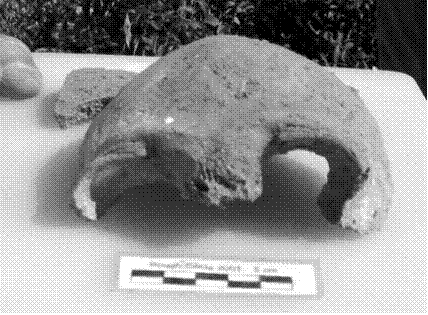
Human Skull Fragment from Gurcam Kale in
Dendrochronology, meanwhile, measures the size of tree rings in woody
tissue that survives from antiquity. Depending on climatic factors such as
excessive rain, cold, heat, or drought, trees adapt by growing more in warm
damp years and less in hot (or cold) dry years due to stress. The sequences of
thick or thin annual growth rings in trees are synchronous across wide spatial
areas. Specialists, such as Peter Kuniholm of
Other means of absolute
chronology include thermoluminescense and some other
examples are discussed in the attached sidebar. The point remains that methodologies capable of furnishing
absolute chronology offer a more certain means of dating archaeological
assemblages, though invariably they remain dependent on the recovery of organic
materials in the same context as the assemblages, something that is inherently
rare.
SIDEBAR: NEW METHODS OF
ARCHAEOLOGICAL INQUIRY
As
an even more remarkable example of "cutting-edge" technologies being
employed to achieve absolute chronologies for remote prehistoric human remains,
one can point to the work of Darryl Granger of Purdue University with cosmic
rays known as cosmogenic nuclides. Granger's research is based on the
principle that as rocks become gradually exposed on the earth's surface become
bombarded by cosmic rays they undergo chemical changes at a measurable rate,
particularly rocks such as marble and limestone. Granger's analysis of chemical
alteration in rocks found in the same closed contexts as prehistoric hominid
remain in eastern and southern Africa has enabled Granger to date these
assemblages with greater precision, in a few cases recalibrating the assigned
date of the remains by hundreds of thousands of years. Given the remote date of
early hominid assemblages, this method has the potential to revolutionize our
understanding of the earliest phases of human development. We recently
collaborated with Granger’s lab on an archaeological project in Turkey:
https://www.cla.purdue.edu/think/stories/2020/spring/rosetta-archaeology-danaisland.html
Relative Chronology furnishes more traditional archaeological means of
dating by comparing archaeological assemblages which bear identifiably
sequential relationships to one another. When assemblages contain datable
remains, such as inscribed artifacts, the datable materials enable
archaeologists to assign dates to otherwise non-datable materials in the same assemblage.
Two standard means of relative chronology are furnished by stratigraphy and
seriation.
Stratigraphy arises from the tendency of human cultures to occupy
the same location over long periods of time, usually because of the
availability of essential resources such as food, water, building materials,
defensive security, or transportation routes. As buildings collapsed and were
rebuilt or remodeled, and over a longer time scale as cultures emerged and
declined, a layering effect of settlement remains occurred (typically in the
form of a large earthen mound or "tel").
Sites bearing remains of long term human settlement can be excavated layer by
layer beginning with the remains of the most recent settlement level, typically
lying near the surface to those of more remote levels, typically lying
underneath. The most celebrated example of stratigraphical
investigation is probably that of the mound of Hisarlik,
presumably the Bronze
Age Aegean site of Troy.
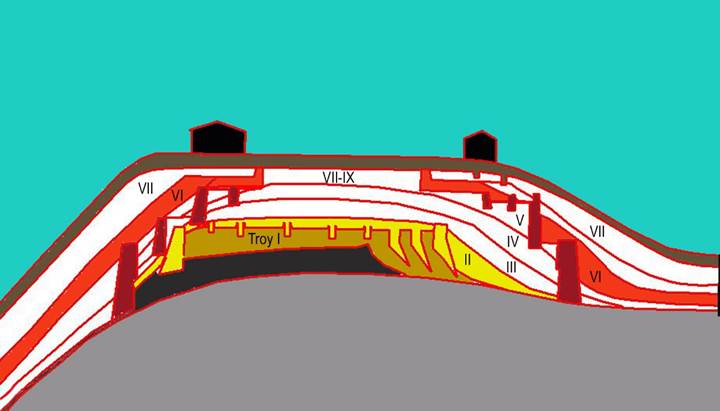
Section View of Stratigraphy at Troy
Naturally, this site is
renowned for its association with Homer's Iliad and the tradition for
the Trojan War. The site is situated on the northwest coast of modern
Seriation entails the concept that human tastes change over time
and that the sequence of these changes can be traced over time. Through
adaptation, innovation, and experimentation tools gradually became better
adapted to the ancient user's needs. If it were possible to obtain a complete
record of the subtle changes that occurred over time with a given artifact --
say, the addition of a handle to a cup, followed by a handle at each end, followed
by the addition of a chalice foot, a folded rim, or some sort of surface
decoration or paint -- and if each phase were to be carefully recorded and
reconstructed from stratigraphical contexts at a
place such as Troy, it would then become possible to reconstruct a reliable
chronological sequence for the evolution of this cup over time and with it the
sequence of all concerned assemblages. This is the basic principle behind
seriation as it is generally applied to pottery sequences. Pottery sequences
remain the principal indicators of chronological dating for prehistoric and
classical era remains, bearing in mind that pottery did not come into being
until ca. 6000 BC. Most ceramic vessels used by a given culture were produced
"locally" and did not circulate very far from their production
centers. Some pottery, particularly finely painted "finewares"
and large containers known as transport amphoras, were carried by ship across
the Mediterranean and by the Roman era across the
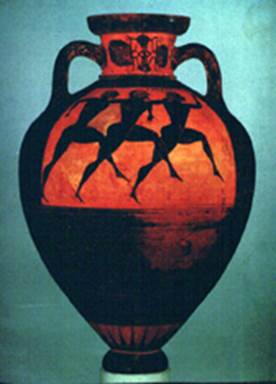
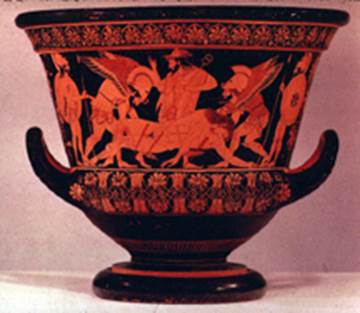
Attic Black
Figure Panathenaic Amphora; Attic Red Figure Krater
Ceramic seriation remains
the most extensively employed means of archaeological dating, particularly for
sites of secondary and tertiary importance that lack any associated texts. Its
drawbacks are evident, however, given that it is based on observed
relationships of stratigraphically recorded materials and is thus highly
interpretive, if not speculative in nature. Even the most rigorously ironed-out
"use-chronologies" of finewares as
exhaustively studied as Attic Black Figure and Red Figure finewares
are regularly and repeatedly subjected to revision.
For a brief primer on
ancient pottery, click
here.
WRITTEN TEXTS
History came into being
with written historical texts, the earliest of which emerged in
Ancient written records
survive in at least three forms: literary
texts, inscriptions, and coin legends. Literary texts are written
records originating from an array of sources such as religious prayers and
observances, poetry, oratory, philosophical texts, and narrative historical
accounts. Most of these can be legitimately identified as 'literature"
because they were deliberately written to be read by a wider audience. Other
texts reflect more immediate historical testimony because they were
"artless," that is, they were non self-consciously written and many
instances preserved by accident. These include records such as correspondence
between friends, kings and subjects, annalistic records such as lists of
priests at temples or list of kings in Sumeria, legal
records such as that of Hammurabi, king of
Documents of various kinds
were preserved in a number of ways. Most documents were originally recorded as
a temporary measure on perishable materials such as dried tablets of clay,
parchment, wood, wax, bone, ivory, and papyrus-reed based paper. The perishable
nature of these media required that documents needing to be preserved
indefinitely be copied and recopied repeatedly or otherwise transferred to more
permanent media. Unless intentionally committed to a non-perishable medium such
as stone or metal, it was usually understood by the writer that the document he
or she recorded was meant to be temporary. Clay tablets bearing Bronze Age
documents, for example, were probably never intended to survive to any great
length of time. However, when fire hardened during the cataclysmic destruction
of their repositories (in many cases at the end of the Bronze Age), their clay
materials underwent chemical and physical transformations that hardened them
and enabled them to survive to present times. Similarly, papyrus scrolls when
preserved in the extremely dry climates such as the Egyptian desert enjoy a
remarkably high rate of survival.
The perishable character of
ancient writing materials leads to a further distinction between the function
of ancient and modern writing. Other than writing for purposes of
correspondence, most materials committed to writing in antiquity were done so
merely for mnemonic purposes, such as memorization per se or to enable the
reader to recite a text out loud. This contrasts distinctly with modern usages
of pleasure reading, reference work, and consultation. To appreciate the full
meaning of ancient texts, modern students need to understand how ancient
writers thought and expressed themselves. In most cases the written form of a
text functioned merely as a preparatory device to some larger purpose such as
an oral presentation or recital. Greater importance was placed on active, oral
communication during ancient times. Written records, even of commercial
contracts, were typically viewed as preserved facsimiles of some instance of
oral expression typically performed in some public environment. In legal
disputes, for example, far more credence was placed in the oral testimony of
eye-witnesses to an agreement at the time of the dispute than to the preserved
written contract of the agreement at the time that it was originally arranged.
This serves as a useful reminder of the ancillary place of writing in ancient
social practice. The distinction between ancient and modern literature likewise
reveals itself quite visibly in other ways such as punctuation and the reliance
of ancient writers on rhetorical sign posts. Most ancient writing systems
lacked punctuation as we know it: a cursory glance at an ancient Greek papyrus
scroll or a Latin building dedication (see the image below) reveals long
strings of characters (oftentimes capital letters) without separation either
with respect to word or sentence. Ancient readers would by necessity "read
aloud" by sounding out the words. Rhetorical devices, known as
"particles," were embedded at the beginnings and ends of sentences to
serve as designators to the length of the expressed thought. Greek rhetorical
expressions such as opote (whensoever), kaitoi
(and yet), and dozens of other particles remain difficult to translate
precisely because their real purpose was to alert the reader to the need to
raise the pitch of his or her voice at the beginning of a sentence and to lower
it at the end. As a result ancient texts
translated into English tend to exhibit a stilted, archaic style that students
find unappealing. Add to this the limited vocabulary of ancient languages and
the tendency for ancient words, particularly verbs, to possess broad shades of
meaning, and the process of rendering texts into modern English in a manner
that is both readable and accurate forms a challenging enterprise. Since all of
the texts employed with this textbook are translated, the adage, "lost in
translation,' need always be borne in mind.
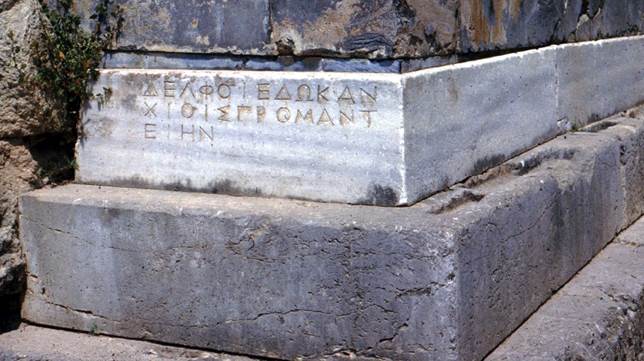
Altar Dedication at
Some written records were
deemed so important that they warranted preservation in a more permanent
manner. Building dedications, such as the initial cornerstone of a Sumerian
monumental building or the altar dedication by the Greek city of Chios at
Delphi shown above, were typically inscribed on blocks of stone by the
person(s) responsible for its construction. Bronze Age stone cutters learned
that documents preserved on stone, once suitably dressed (that is, given a
smooth flat surface capable of displaying written characters and figural
relief), tended to withstand the ravages of time. Ancient record keepers
quickly recognized the record-preserving quality of dressed stone. Rounded
column drums, smoothed wall block, and particularly tall, thin tablet-like
blocks known as stelai
became media for the preservation of public records as early as the Late Bronze
Age (1450-1100 BC). Inscriptions preserved on stone include building
dedications, royal and municipal decrees, popular legislation, and religious
laws, accounts, and observances. The smoothly dressed wall surfaces of a
Greco-Roman council house typically preserved that body’s official
correspondence with allied polities, kings, and emperors, ultimately
constituting a form of municipal archive. Tens of thousands of inscribed texts
have survived to modern times, most after having been unearthed through
excavation. Every year hundreds more inscriptions come to light. The science of
investigating inscriptions of all kinds, epigraphy (literally the study
of things "written upon") includes not only texts preserved on stone
but also those painted or stamped on ceramic vessels, engraved on metal
objects, painted on plastered walls, and embedded in mosaics.
A more specialized area of
epigraphy concerns numismatics, the science of ancient coin studies.
Coins purportedly were invented by the kings of
The value of inscribed
records needs to be kept in perspective. Since many inscribed texts reflect
official policy at various levels, the language tends to be redundantly
formulaic. Others, such as amphora stamps, served as little more than inventory
marks intended to comply with the customs regulations of a given state. In
other words, inscriptions rarely furnish anything literarily significant. They
are what they are, typically the mundane records of formalistic procedures.
However, inscriptions do have the advantage of preserving texts that are
directly contemporary to the events and personages they record, as opposed to
literature such as ancient biographies which were typically written centuries
after the lives they recount and were heavily slanted with bias. Frequently the
content of texts inscribed by one generation could prove vexing to later
generations, such as the dedications of Queen Hatshepsut of New Kingdom Egypt (1508-1458 BC) whose long rule was
resented by her son Tutmosis
III. When Hatshepsut died Tutmosis had her
name removed from all public monuments (damnatio
memoriae) and replaced with his own. Incised
deeply into the chiseled surfaces of stone building elements, these rasurae, literally hand cut erasures; render it
impossible for Tutmosis to hide his act of jealousy
through to this day.
Two further questions need
to be addressed with respect to writing; who was literate and how widespread
were written texts during antiquity? The question of literacy has received
considerable attention in recent years. During the Bronze Age when few below
the level of elite scribal classes learned to read and write, literacy remained
a privileged advantage of a small percentage of the population, probably less
than 5%. The survival of published legal codes and thousands of commercial
contracts indicate that some elements of the wider population were at least
semi-literate or perhaps functionally literate. But one must avoid exaggerating
this assumption. Today in the public squares and tea gardens adjoining
government centers in Turkey, typists, literally men adept with manual typewriters,
sell their services, typing official forms such as application forms for
drivers' and marriage licenses, and residence permits for everyday people. In a
pinch the authors have relied on the services of these typists to complete some
required government form. To what degree the clientele of these professionals
is literate and otherwise capable of completing the forms themselves remains a
legitimate question. Similar professionals undoubtedly existed in Bronze Age
Mesopotamian cities, creating 'contracts' on clay tablets on request for others
who could not read. During the Classical era scholars assume that the free born
citizen elements of Mediterranean communities were more or less literate, based
in part on advances in writing systems that rendered them more accessible to
lower class elements. The overwhelming evidence for the existence of
educational facilities and requirements at the foundation of Greco-Roman
civilization also argues to this end. The extent of literacy among the wider
population remains debatable, nonetheless.
Based on the numerous
references to the existence of libraries, not only private, such as that owned
by the tragedian Euripides or the dictator L. Cornelius Sulla, but state-owned
libraries at cultural centers such as Alexandria, Antioch, Pergamum, Ephesus,
Athens, and Rome, it is clear that text documents existed in considerable
numbers by the height of Classical antiquity. Allegedly the great Ptolemaic
library at Alexandria preserved more than 1 million volumes (literally papyrus
scrolled rolled around wooden spindles, each scroll representing a 'book",
each separated block of text a "chapter,' each line of text a 'verse').
The holdings of the imperial library at
Classical scholars are
fully aware of the impact of these losses over time. Of the 142 books of Roman
history written by the great historian, Livy, only 45 survive; numerous
tragedies and comedies of the great dramatists of Classical Athens remain lost,
and for many eras the written records are so thoroughly lost that our ability
to reconstruct them is limited. We would certainly know more about the events
and personages of the classical world if only we had the complete works of the
authors whose fragmentary writings survive, never mind the writings of other
authors completely lost today. However, this deficit needs to be put in
perspective. Ancient writers, especially literary writers, were by and large
aristocrats who wrote for an audience of fellow aristocrats. The mindset of
this social element prevented its literary community from recording the events
of their experience in an altogether useful manner. To a large degree the
substance of the literature of the classical Mediterranean world,
unquestionably the most extensive literature to exist on the globe at that
time, amounted to little more than a recounting of the experience of
"Great Men and Great Events." The Classical world was predominantly one
dominated by aristocracies, local, regional, and imperial. An aristocratic
ethos therefore prevailed. Although this perspective would have been very
familiar to lower class elements living in
Due to their wealth and
status ancient aristocrats enjoyed something the Romans referred to as otium,
or freedom from subsistence labor. They relied on the work of other people to
furnish them with the necessities of life, thus freeing them to devote their
energies to "nobler pursuits." These last were invariably enumerated
as individual contributions in religion, politics, and warfare. Little else had
any value to an aristocratic career. Recognition of the value of the artes liberalae
enabled aristocrats to tolerate the fact that some of their peers would pursue
careers as poets, writers, artists, and sculptors, but the true job of an
aristocrat was to lead his community through one of the recognized noble
pursuits. It is interesting to observed, for example, the embarrassment
expressed by the Syracusan aristocrat and scientist, Archimedes, when lamenting
his decision to pursue an scientific career in Alexandria as opposed to the
political career that was expected by his family and its dependents. This
mindset is equally prevalent in the surviving literature of past civilizations.
Aristocratic writers committed to text only those events that they and their
noble audiences deemed worthy, in other words, accounts of aristocratic success
in the acts of religious, political, and military careers. Lower class
elements, and especially women, were rarely mentioned in this literature, only
to the extent that they intrude in the aristocratic narrative. As a result, the
textual literature of the Classical World Civilizations is as slanted and as
limited in perspective as the literary community itself. One has to delve
deeply and creatively into these texts to obtain the kind of information that
cultural historians require to address these subjects for today's reading
community. To probe beneath the surface of this literature and to peer into the
world of everyday people in classical antiquity stands as one of the most
formidable challenges confronting classical scholarship today.
For this reason, despite
the existence of texts that illuminate the era of the Classical world, scholars
such as the author rely extensively on archaeological data and models arising from
the social sciences to inform ourselves about everyday conditions in the
Classical world. In other words even with the significant textual records that
survive from the Classical era, we are dependent on the archaeological record
to reconstruct the patterns of existence for everyday people like ourselves.
Archaeological data furnishes the "remote background noise of
history" and enable historians to direct focus away from the bias of
ancient written sources for the experience of elite cultures to the reconstruction
of the historical experience of everyday people. Ancient historians and
archeologists can also use archaeology to identify the juncture between
"Great Men and Great Events" and the evolving record of la longue durée.