CWC PRIMER CHAPTER 3:
HUMAN PREHISTORY
CHRONOLOGY and THEMES:
Paleolithic Era c. 6.5 million BP-9,000 Before Present (BP), Humans as
hunter-gatherers
Ø About 6.5 million BP a population of African apes split
into two distinct species. One of these evolved into human beings. The other to
chimpanzees.
Ø About 4 million BP the hominid species,
Australopithecus, began walking predominantly in an upright stance.
Ø Around 2 million BP homo erectus began fashioning
tools
Ø Emergence of Modern Humans in Africa; ca. 200,000 BP;
earliest migrations out of Africa, ca. 150,000
BP
Ø Pleistocene Era ca. 2 million-9000 BP; influence of
climate changes on human development
Ø Neolithic Revolution c. 8000-7000 BC in the Near East,
domestication of plants and animals
The purpose of this chapter
is to explore human development from its origins through to the advent of
settled agricultural existence. Human settlement, based on the domestication of
plants and animals, has long been identified as having occurred around
8000/7000 BC in ancient Iraq,
This region is known to scholars as the Ancient Near East or as Mesopotamia. The latter term is the ancient Greek word
for the land between two rivers, namely, the Euphrates and the Tigris. During prehistoric times the Ancient Near East
functioned as a land bridge between Africa where modern humans originated
around 200,000 BP and other regions of human habitation, including Eurasia, East Asia, Australia,
and the Americas.
According to the available evidence modern humans migrated from Africa as far
as the Americas
between 150,000 and 24000 BP. The evidence for these conclusions is susceptible
to revision due to the accelerated pace of discovery during the past decade.
Alongside traditional analysis of archaeological assemblages of prehistoric
remains, current investigators utilize an array of tools to reconstruct this history, including
genetic mapping -- of both humans and other organisms -- climatology (to
explain human migration during the ice Age) -- and linguistics (using language
history to confirm the results of the other methods). To be certain, much of
this research is speculative and subject to intense debate even among
specialists. However, the unquestioned reliance placed on DNA evidence in
judicial procedures as well as the importance of climatological evidence to the
current debate regarding global warming demonstrates the need to take this data
seriously.
Before proceeding there is
need to address the issue of deep seated religious beliefs and to reassure the
reader that the purpose of this work is not to challenge these. The objective
here is to present a summary of scientific data obtained through empirical
research that addresses human origins. These findings in no way deny questions
of faith. As will become apparent, this book exhibits a healthy respect for all
religious world views. Along with fields such as philosophy and astrophysics,
religion is one of a few disciplines that asks the vital questions, why are we
here, where did we come from, and where are we going. Having said this, the
increasingly consistent record that is emerging for human origins, confirmed by
a bewildering array of scientific data, inevitably confronts the written record
of ancient religious texts. The latter were compiled by humans, however
divinely inspired, without the benefit of modern science or technology. If
anything, the scientific data has demonstrated that human origins are far more
complicated that religious thinkers writing around 1000 BC in ancient Israel, for
example, could have conceived. These findings in no way discard essential
questions regarding the existence of god. As we contemplate the significance of
the 'Big Bang' some 10 billion years ago, the finite character of the universe
expanding through a limitless void of space, or the formation of the planet
earth some 4 billion years ago, it becomes difficult to comprehend the purpose
of existence by other means than faith.
Prehistoric Africa
Africa is the second largest landmass in the world. It is
also the highest and the oldest landmass in the world. The continent presents
itself as a vast plateau, rising steeply on all sides from various coastal
strips and extending along a north-south axis. Mountains and divides form
basins in various regions, most notably the basin of the Congo
River, at the Equator, where the rain forests are very dense. The
vast unbroken extent of the African plateau causes rivers to drain through
cataracts and magnificent waterfalls on their way to the sea. Apart from the Nile, no African rivers are navigable beyond the coast.
The continent's most remarkable feature remains the Great Rift Valley, formed
by the tectonic movement of the Arabian landmass away from Africa.
Over tens of millions of years this earth movement created long, deep valleys
southward through the African plateau. Several of these valleys form large
enclosed highland lakes. Lake Victoria,
sitting 3700 ft above sea level, is the third largest lake in the world. Waters
beginning in this region flow northward 4000 miles to form the two branches
(White and Blue) of the Nile, the longest
river in the world. The Great Rift actually extends beyond the continent under
the Red Sea all the way to the Dead Sea/Jordan River valleys of Israel. It is
here along the cliffs of the Great Rift Valley in Africa
that the earliest remains of humans have survived.
As the accompanying table
displays, DNA analysis indicates that archaic humans or hominids evolved from
African primates approximately 6.5 million BP. DNA of modern humans has been
demonstrated to be 99% compatible to that of Chimpanzees, for example.
SPECIES FOSSILS DNA
PROXIMITY TO HUMANS
|
Primates
|
35 million BP
|
|
Baboons
|
30 million BP
|
|
Gorilla
|
10 million BP 97%
|
|
Chimpanzee
|
8 million BP 99%
|
|
Hominids
|
6.5 mill. B 100%
|
Many attributes that
primates hold in common with humans -- including stereoscopic vision, sexual
pairing to care for young, group social behavior, and the tendency to use fore
limbs to perform tasks other than locomotion -- clearly facilitated human
development. Around 4 million BP hominids known as Australopithecus descended
permanently from the canopy of the African rain forest to walk in an upright
manner. Apart from the obvious advantage this had in freeing hands to perform
work and to fashion tools (and thus render food gathering and preparation more
amenable), the most significant development in this regard was the anatomical
transformation associated with upright posture. By balancing the cranium on the
spinal column, hominids reduced the need for massive muscular structures that
quadrupeds utilize to suspend their heads out in front of their forelimbs. When
one looks at images of apes and other mammals such as horses, lions, and cows,
the size of their neck and shoulder muscles is striking especially in
comparison with those human. These muscles are connected to the skull by means
of bundled sinews of ligament and tendon the weight of which, suspended,
actually restricts the size of the skull. By balancing the cranium on the
spinal cord through upright poster, archaic humans reduced the need and
therefore the size of these muscle parts, albeit gradually and imperceptibly
over millions of years. As muscles receded cranial capacity (and brain size)
expanded, enabling hominids to gain in intelligence and advance ahead of their
primate relatives. Advances in tool use and manufacture, emerging social
formations based on extended clans, hunting bands, and tribes, and even the
harnessing of fire by 350000 BP all reflect advances made by archaic human
species during Paleolithic times in Africa,
all prior to the advent of modern humans.
SIDEBAR:
HOMINIDS
Australopithecus hominid, 6-2 mill. BP
Theoretically,
upright posture resulted in anatomical changes; front limbs were freed for tool
use and food preparation, reducing muscular structure of skull and expanding
cranial capacity.
A
second factor in human development during prehistory was climatic; namely, the Pleistocene
Era, 2 million - 9000 BP
(Ice
Ages) see below
Homo Erectus, 1.6
mill.-400,000 BP, first out of Africa 1.2 million BP (Europe, China).
More than a dozen species
of archaic humans existed in Africa during this
period, most of which wandered off into extinction. Populations of hominids
appear to have risen and collapsed as they confronted changing environmental
conditions. Approximately 2 million BP
hominids known as Homo erectus began to fashion stone tools (chipped and
flaked stone tools, bone tools, and fire) and to enjoy greater mobility. By 1.2
million BP elements of this species migrated out of Africa, wandering as far as
East Asia by 400,000 BP. Climatological
evidence indicates that the impetus for this migration was environmental,
originating with the advent of the Pleistocene era (Ice Age) around 2.5 million
BP. Recent analysis of climatological and paleoenvironmental
data now demonstrates that the intensely variable climate that occurred
globally between 2.5 million and 9000 BP played a defining role in human
development, at the very least by limiting and shifting the habitable regions
of the globe. The timing of the movement of Homo erectus out of Africa in association with the emergence of the Ice Age
is too uncanny, for example, for these to have been coincidence. This needs to
be sorted out more fully before proceeding with any discussion of human
origins.
Pleistocene Era
Researchers since the 1950s
have greatly revised our understanding of the Pleistocene era, a geological
time period characterized by variable climate punctuated by extreme changes
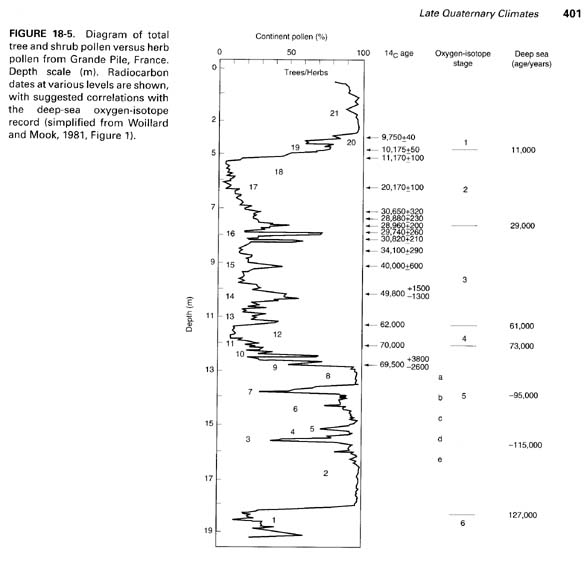
between colder and warmer weather globally. Analysis of numerous indicators,
including measurements of oxygen isotopes in artic ice cores, vestiges of
highly sensitive organisms in sea floor sediments, residue of tree and grass
pollen from lake sediments, and even remains of climatically sensitive
materials such as beetle remains and cave deposits (speleotherms),
all demonstrate a trend toward global cooling during this period. This trend
was reflected by steeper latitudinal climate gradients and increased
seasonality and variability. The causes of global cooling are so complex and
interrelated that they defy simple explanation. Potential factors include
lithospheric plate motions, vertical tectonism, weathering reactions,
fluctuating atmospheric CO2 content, volcanism, biologic evolution, changes in
oceanic circulation, and cyclic variations in the earth's orbit around the sun.
The geomorphic results have been spectacular, culminating in a series of ice
ages that repeatedly covered as much as 30% of the land area with glaciers
(Bloom 1998; 49). Since the reversal of the earth's magnetic field about
750000 years ago the planet has undergone at least seven phases of glaciation.
Ice cores obtained from Antarctica indicate
that cold prevailed for much of this period, especially during the last 400,000
years. Sustained periods of cold climate were interspersed by much shorter warm
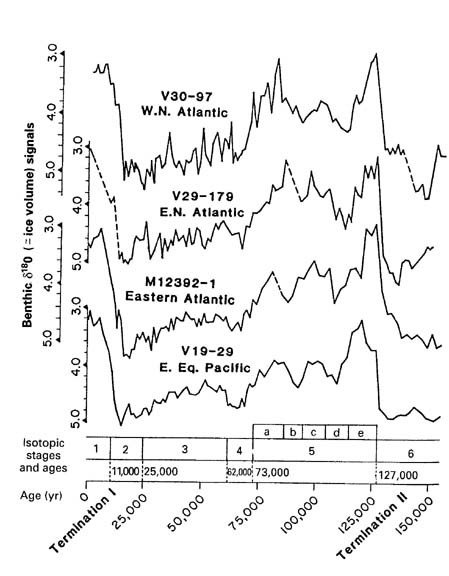
periods known as interglacials. The pattern was
clearly a global phenomenon as the same features are evident in the data
obtained from ocean sediment cores in the tropics as they are from polar ice
cores. Since around 400,000 BP, the pattern has been broadly consistent. Each
ice age ended rapidly and was followed by an interglacial lasting around 10,000
years. The climate then slipped back into long sustained periods of glacial
coldness, thus lending the temperature record a remarkable saw tooth appearance.
(see chart)
As opposed to today, where
sea water is evaporated and deposited on land as rain eventually to work its
way back to the sea, Ice Age atmospheric moister was deposited on land surfaces
as snow and gradually accumulated into ice sheets that at their peak in 27000
BP rose to more than 3km in altitude. In the northern hemisphere, where most of
the planet's landmass is situated, the ice extended southward to form a line of
glaciers extending from Chicago across the north
Atlantic to Glasgow and Stockholm. At their greatest extent these
massive ice sheets not only made higher latitudes much colder than today,
especially during winter, but their great height meant that weather systems
flowed around their fringes rather than northward across the artic basin in
confluence with deep-water ocean currents. This had the effect of shifting all
weather systems farther south. At the same time, as more and more sea water
evaporated and became permanently deposited on land surfaces, the sea level
plunged as low as 130m below current levels, exposing some 25 million km2
of coastal shelf. Neighboring regions such as Britain
and Europe, Indonesia and Australia, Siberia and Alaska became linked through now submerged
land bridges. These exposed coastal lowlands and land bridges formed
passageways for human migration and survival during Paleolithic times. The
extreme variability of the Pleistocene era needs to be emphasized. The interdecadal variance in temperature and its impact were
some tenfold greater than today, rendering the Pleistocene climate immeasurably
more demanding. Early humans and the life forms they depended on for survival
had little choice but to adapt to a flexible and migratory lifestyle in order
to survive.
During sustained periods of
intense cold, areas such as Europe north of the Pyrenees, the North American
plains, the Middle East, and the Sahara became
extremely cold, arid and uninhabitable. Flora and fauna in these regions either
migrated to more habitable environments or went extinct. Discernible patterns
have emerged regarding which areas supported human life during these long
periods of intense cold. Habitable regions included the more temperate lands
near the equator such as central Africa, southeast China,
Indonesia, Australia, and New Zealand, all of which show
evidence of moderate cooling at worst. They also included coastal lowlands of
the Mediterranean, Red Sea, Indian and Pacific Oceans,
where the presence of the sea helped to moderate cold temperatures and
furnished early humans with aquatic food sources. In addition, early humans
came to inhabit extensive east-west trending regions of grassland and tundra in
eastern Russia and southern Siberia. As difficult as this may be to comprehend, these
regions were too distant from large bodies of water for ice sheets to
accumulate. Archaeological remains indicate that they teemed with animal life,
particularly large herbivores such as mammoths and reindeer, thus enabling
populations of hunter gatherers to flourish. Lastly, even in the frigid cold of
Europe various refugia,
or isolated pockets of wetlands, sustained human and other forms of life in
mountainous regions along the northern shore of the Mediterranean
and the Balkans.
SIDEBAR; ARCHAEOLOGY OF THE ICE AGE
Global cooling,
and with it a trend toward steeper latitudinal climate gradients and increased
seasonality and variability, seems to have been the climatic trend through the
Cenozoic era (65 mill.BP-present). The causes are so complex
and interrelated that they defy simple explanation. Potential factors include
lithospheric plate motions, vertical tectonism, weathering reactions,
fluctuating atmospheric CO2
content, volcanism, biologic evolution, changes in oceanic circulation, and
cyclic variations in the earth's orbit around the sun. The geomorphic results
have been spectacular, culminating during the last 2.5 million years in a series of ice ages
that repeatedly covered as much as 30% of the land area with glaciers. Even
today, in what some refer to as "postglacial' time with excessive
optimism) 10% of the land remains ice covered, including the entire continent
of Antarctica and most of the larges t island, Greenland. We are living in an
ice age although all 6000 years of recorded human history have been within the Holocene epoch,
one of the numerous brief interglacial intervals when the extent of the ice
cover has been reduced. (AL Bloom, Geomorphology a Systematic Analysis of
Late Cenozoic Landforms (Prentice Hall, 1998), 49)
During periods of sustained
cold the effects of climate change were felt even in
warmer regions such as equatorial Africa. Food resources which archaic humans
depended on for survival diminished and populations accordingly declined,
entering into genetic moments known as "bottlenecks". Eras of
climatic intensity imposed extraordinary stress on human development,
compelling archaic humans to adapt, by developing stone tools, for example, and
by migrating.
Homo erectus, for example,
migrated out of Africa via the Middle East around 1.2 million BP, and pursued
an eastward trending route along the more temperate, exposed coastal lowlands
of the Indian and Pacific Oceans all the way to China. This route was repeatedly
utilized by early humans in following millennia. By 500,000 BP a species known
as Neanderthal migrated out of Africa into the Middle East and northward into
Europe where they adapted to the harsh climate and survived as hunter-gatherers
until around 30,000 BP. Surviving primarily off large mammals these people
enjoyed enormous stature (on average 30% larger than modern humans), tremendous
body strength, and cranial capacity in fact larger than modern humans. Modern
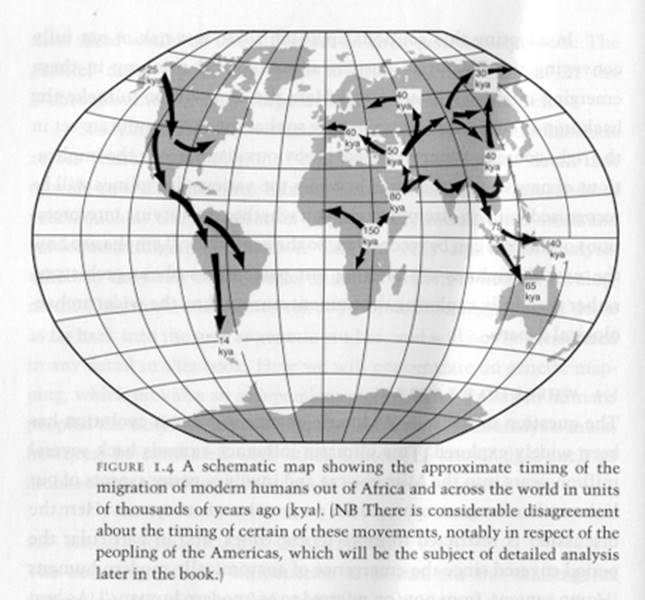
humans in turn appear to have migrated repeatedly out of Africa, first around
150,000 BP, then around 74000 BP, and finally around 50,000 BP.
Migrations of Homo sapiens
DNA analysis indicates that
modern humans (Homo sapiens sapiens) originated around 200,000 BP in the
region of the African Great Rift. This is confirmed by the discovery of human
remains in Ethiopia,
dated to 160000 BP. Geologically this coincides with the penultimate era of
glaciation that occurred from 330000-130000 BP. The period was characterized by
extreme desiccation across much of Africa and
probably led to widespread population collapse among archaic humans living in
the continent at the time.
Through analysis of
mitochondrial DNA obtained from females of various ethnic backgrounds,
researchers have determined that all humans alive today descended from one
female, commonly referred to as 'Eve', who lived approximately 7600 generations ago.
Analysis of male Y chromosome samples obtained from throughout the globe
reveals the existence of some 10 "descent groups" or haplotypes that
presumably descended from a common male ancestor who mated with Eve. Eve, her
hypothetical mate, and these 10 males were not the first, nor the only modern
humans living in Africa at that time. Rather,
these were the only people from a much wider population of modern humans whose
progeny survived until today. Due to the challenges of intense climate change
and variability, these elements also began to move about the landscape. Some 20
haplogroups have been identified based on lineage
sequences in male Y chromosomes. One haplogroup moved
southward in Africa to become the Khoisan or
Bushman people, apparently the group most closely descended from the earliest
modern humans. Others settled in the rain forests to become pygmies and others
still, living in the grasslands north of the central African rain forest
survived as Negroid elements who as Bantu speaking cultures came to dominate
sub-Saharan Africa.
Most early modern human
population remained in Africa, but some small portion of the population
migrated to the Middle East around 150,000 BP.
The remains of this culture have been found in caves
at Skhuyl and Quafzeh in
modern Israel,
dated to 100,000 BP, in close vicinity to Neanderthal settlements.
According to the data
obtained from genetic mapping, however, this first migration ultimately failed,
probably due to a prolonged phase cooling that set in around 100,000 BP. When
this era of advancing glaciation reached its minimum temperatures around 87000
BP the Middle East ceased to be inhabitable.
Intriguingly, mtDNA research of dog chromosomes
indicates that dogs separated from wolves at approximately the same time.
Conceivably this genetic marker records the moment at which dogs began to
cohabitate with humans, though the earliest actual evidence for this does not
emerge until 14000 BP.
Human assemblages found on
the Red Sea coast of Africa, dated to 125000 BP, combined with the evidence of
genetic-mapping indicate that a second migration out of Africa
occurred around 80,000 BP, possibly as a result of dramatic sea level decline.
As opposed to the first attempt at migration, elements of this migration
successfully moved along the shores of the Red Sea, Indian Ocean and the
Pacific, utilizing land bridges and narrowed seas to arrive in Australia by 60,000 BP, and Southeast
Asia by 40-35,000 BP. The genetic evidence indicates once again,
however, that many elements of this second wave -- apparently all those
dwelling in regions west of Indonesia
and east of Africa -- disappeared as well.
Another dramatic cooling event, dated by ice cores to 75-70,000 BP, and
intensified possibly by the eruption of a super volcano, Mt. Toba in Malaysia
in 71,000 BP, appears to caused another mass extinction. Like Homo erectus,
however, those modern humans who had successfully migrated beyond Malaysia to Indonesia,
Australia and New Zealand
appear to have survived. Genetic mapping of Y chromosome data indicates that a
third migration out of Africa occurred around 55,000 BP during a warming trend.
This migration repopulated the Middle East and continued on through central
Asia into Siberia by 40,000 BP. These elements then diverged in separate
directions. Some headed westward along the northern shores of the Caspian and Black Seas
in to Europe, arriving around 40,000-35,000
BP. Others headed eastward through Siberia, China, and Mongolia to Beringia,
where the existence of a land bridge enabled them to cross into Alaska and
North American by 25,000 BP. Other migrating elements independently moved
eastward along the Indian Ocean to repopulate
those areas abandoned during the earlier migration. This is the only viable
explanation for the marked genetic divide that exists between people living
today in east Asia, New Guinea, and Australia, and those living in India and
farther west. This picture is complicated even more by genetic markers
indicating that other humans descended from the time of the earlier migration
in 84,000 BP had by this time likewise made their way to China and Japan. These
humans also migrated across Beringia into the Americas. Before this occurred,
however, another glacial era descended on the planet between 35,000 and 24,000
BP.
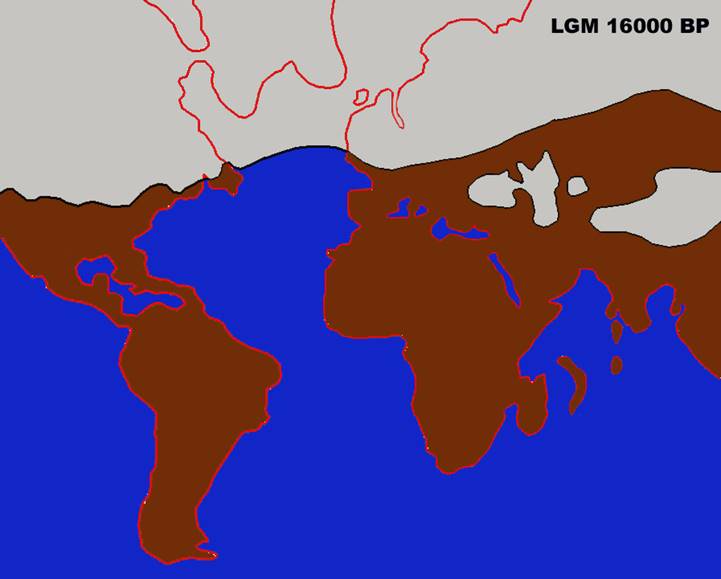
Map of the Last Glacial Maximum
Known as the Last Glacial Maximum, or LGM, this
final phase of the Pleistocene era represented the most intense period of
glaciation in human experience. The millennia between 20,000 and 18,000 BP in particular
represented a period of unrelenting cold throughout the planet, culminating in
the 3km tall ice sheets mentioned above. In comparison with today's global ice
cover of 30 million km3 the ice cover of the LGM was literally 3
fold, or 90 million km3. Sea levels plunged by 130m. The LGM appears
to have wiped out the Neanderthal populations in Europe
and unquestionably impaired the progress of modern humans as well. Fortunately,
these latter populations were sufficiently well situated by this time, and
adequately armed with tools and technologies to hunker down in their various
regions of the world and survive.
Origins of Race
It is important to
recognize that the bulk of the modern human population remained in Africa throughout these eras. This had an enormous impact
on the way humans evolved. One researcher compared the repeated exodus of small
groups of modern humans to the equivalent of removing the playing cards, 7, 8,
and 9, from a deck of 52. Those populations that remained in central Africa, by and large thrived in its moderate climate,
continued to mix their gene pool, and otherwise developed attributes of
"complex societies." Already before 70,000 BP (the period during
which modern humans migrated as far as Australia), African cultures exhibited
components of what is referred to as a "Paleolithic Revolution,"
including blade and microlithic technology, bone
tools, increased geographic range, specialized hunting, exploitation of aquatic
resources, long distance exchange networks, systematic processing of pigment,
art and body decoration. Although the archaeological evidence for these
attributes of modern human cultures does not occur in combination at any one
place or time in Africa, the overall picture
suggests that their packaging was assembled prior to the departure of migrating
bands to distant continents around 84,000 BP. These same attributes become
manifested as rock art in Australia, cave art in Spain and France, a bone flute
found in Germany (39,000 BP), kiln-fired ceramic figurines in Moravia (20,000
BP), kiln-fired pottery in Japan (14,000 BP), and exotic grave good in the
Middle East and Europe, the last mentioned demonstrating the existence of
social hierarchy and trading networks.
Small groups of modern
humans obviously carried these
attributes out of Africa prior to their
becoming isolated by insurmountable barriers of mountain, desert, glacier, and
ocean, only to lose contact with one another for tens of thousands of years.
What is more, the variability of the Pleistocene era with its repeated,
sustained periods of intense cold inevitably reduced those populations that
migrated out of Africa significantly.
Fluctuations in human populations had a huge impact on the rate at which
natural selection operated, leading to a phenomenon known as genetic drift. During genetic
drift decline in breeding numbers induced changes in the genetic composition of
an isolated human population. As population levels fell to very low numbers,
simple chance allowed some genetic variations to spread through the surviving
population in lieu of others that disappeared altogether. In such a situation, genetic
drift, genetic bottlenecks, and founder's effect influenced the
genetic record of this group not so much through "survival of the
fittest" as "survival of the luckiest." (Burroughs 139) Another
theoretical outcome of widespread population decline was the occurrence of
genetic bottlenecks. As human populations declined everywhere except Africa
around 100,000 BP, for example, those small elements that survived would have
found themselves dispersed into geographically separated groups. As populations
rebounded tens of thousands of years later, each group started from what was
essentially a separate genetic base. In Africa
the DNA evidence indicates that these separated elements of modern humans
continued to mix with one another as their populations expanded and merged.
However, those handfuls of groups that migrated out of Africa
inevitably colonized the rest of the world based in their particular group's
unique genetic heritage. In essence they forged a genetic bottleneck out of
which all non African based populations of modern humans ultimately arose.
It is generally assumed,
for example, that such a bottleneck occurred around 80-70,000 BP for the
reasons given above. The genetic evidence indicates that the global human
population crashed at this time to a maximum of 40,000 people. The genetic
lineage of the resurgent populations who began migrating around 50,000 BP was
inevitably different from that of earlier migrating humans. Climatically
induced changes in their level of development are likely. Researchers mapping
the mtDNA of human body lice have determined, for
example, that the particular species of louse that infests human populations
evolved at approximately the same time (70,000 BP). Since the genetic lineage
of this particular louse directly descends from animal lice, the evolution of
human head lice is presumed to mark the moment at which modern humans began to
fashion clothing from animal skins to keep warm.
**********************************
SIDEBAR: Dogs, Fur, and
Human Head Lice in the Americas
DNA
evidence of head lice, two genetic lineates that
separated ca. 1.2 million BP. This coincides roughly with the time when archaic
humans, Homo erectus, first ventured out of Africa.
These humans lived in East Asia until about
50,000 BP, and the only way modern humans could have picked up their form of
louse is by some social contact. The geographical distribution of the two forms
of louse is also interesting. One is found on people all over the world, the
other is almost exclusive to the Americas. This suggests that the
modern humans that crossed Beringia into the Americas carried the form of louse
that had survived for so long on our human cousins, Homo erectus. (Borroughs 133).
Over time the natural
process of genetic mutation caused isolated populations to "adapt" in
various ways, particularly in terms of their physical appearance. Geneticists and
molecular anthropologists have determined, for example, that the genetic
variants that determine skin color and facial features involve only a few
hundred of the billions of nucleotides in human DNA, a genetically
insignificant number. Two classes of melanin, red/yellow and black/brown, are
present in the epidermal layer of human skin and hair. The spectrum of
pigmentation observed in different geographic regions of the world is the
result of varied production, distribution, and packaging of these two classes
of melanin among long isolated populations. Those most exposed to strong
sunlight, such as humans dwelling in African grasslands near the equator,
needed to generate large amounts of melanin to defend their bodies against
harmful UVA sunlight. The genetic "hard-wiring" of people in these
regions led to the evolution of Negroid peoples who eventually came to dominate
most of sub-Saharan Africa. As isolated
elements of modern humans migrated into less sunny climates, however, their
body chemistry's need for melanin diminished in inverse proportion to the need
to generate Vitamin D from diminished sunlight, and thereby avoid diseases such
as rickets. The genetic markers that controlled melanin production for these
people inevitably 'relaxed," enabling mutations in the direction of
lighter colored hair and skin. As a result, northerly situated humans acquired
lighter, paler skin, lighter colored eyes, and reddish and blond colored hair.
Similar transformations
occurred with respect to body size and proportion that affect human
thermoregulatory response to varying climates around the world. Longer slender
frames were more suitable to hot climates, whereas, stocky, thicker frames that
retain body heat were more suitable to cold. Similar explanations have been
made for the shape of the nose, width of nostrils, and texture of hair. The
time required for adaptations such as these to take hold was hardly brief,
perhaps as many as 500 generations (10,000-12,000 years), but neither was this
necessarily long in archaeological terms. Theories about genetic drift,
bottlenecks, and founder’s effect furnish, therefore, not only some sense of
proportion to the scale of the migration that left Africa, but it also
demonstrates that all other people of the world, regardless of their
appearance, descended from one and the same human stock, however separated by
time, barriers, and distance.
The Emergence of Human
Settlements
During the LGM enormous
changes in human populations took root throughout the globe. Homo erectus was already extinct before
50,000 BP, though not before coming in contact with modern humans heading
toward the Americas.
Neanderthal culture likewise went into extinction around 30,000 BP. In Europe
three distinct Paleolithic cultures of modern humans are discernible: Aurevignian in southern France
and Spain, Gravettian in the Balkans and Black
Sea area, and Solutrean in the
Pyrenees/Basque region. Thriving on food sources of large herbivores and
positioning themselves along their migration routes. These cultures exhibited
advanced levels of culture and social organization, as demonstrated by their
magnificent cave art, highly perfected stone and bone tools, and body
decoration. With the end of the LGM around 16,000 BP and the trend toward
warmer climate this rather hearty lifestyle was overturned as their food
sources migrated northward or were hunted into extinction. Rapidly changing
climate conducive to population rise around 10,000 BP anticipated the final
transformation in human development, commonly referred to as the Neolithic
revolution.
Neolithic
Revolution
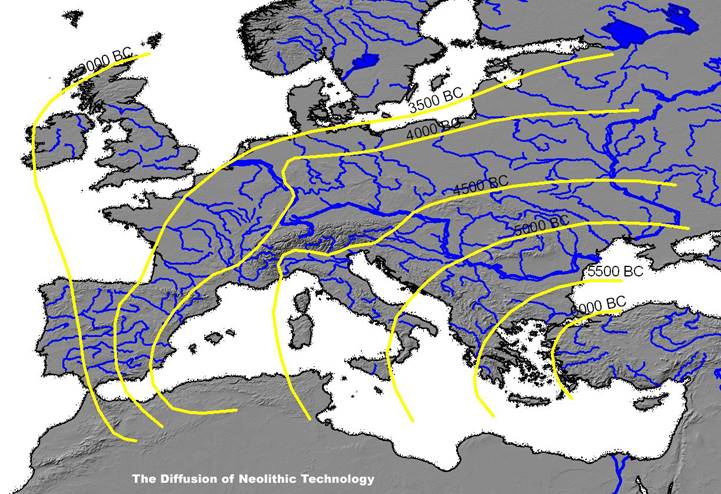
The driving force of the
Neolithic revolution is identified with a dramatic shift in climate at the end
of the Pleistocene era, something known as the Younger Dryas era that occurred 12,900-9,500
BP. Prior to this period, around 15-13,000 BP a dramatic warming trend
generated expanding vegetation and more abundant yields of wild fruit, seed,
and game animals in many parts of the globe. These in turn altered lifestyles
for several modern human populations. In Europe north of the Mediterranean
this meant the emergence of vast forests that severely reduced the available
grazing territories of large herbivores. Animals such as mammoths quickly went
into extinction while others such as reindeer migrated further northward as
glacial ice sheets retreated leaving tundra and grasslands in their path.
Big-game hunter gathering as a lifestyle thus became threatened. The
inhabitants of this region were compelled to radically change their diet from
one dominated by reindeer to one dominated by forest-oriented deer, boar, and
oxen. A likely indication of this is afforded by the genetic lineage of Basque,
Celtic, and Finnish peoples, which has now been shown to be directly related.
Apparently, at the end of the LGM, those populations surviving in the Pyrenees
(today known as the Basques) migrated northward through France, Britain,
Ireland, and Scandinavia following their animal food sources. Investigators
theorized that this migration continued southeastward into the Baltic region of
central Europe, thus imparting the ancient
Celtic population with its uniquely dispersed pattern of settlement. Other
peoples migrated into the region from the Black Sea region as well as the
Middle East; however, it is significant to observe that some 80% of the
contemporary population of Europe owes its descent to the peoples who migrated
into the continent from central Asia around 40,000 BP, whereas, only 20% can trace
its genetic lineage to the Middle East.
In more temperate regions
such as the Middle East, China,
and South America formerly arid landscapes
became remarkably lush in plants and small game. Hunter gatherers dwelling in
these regions adapted to harvesting these resources out of necessity. For
example, the Natufian culture in Syria and Israel,
14.5-12000 BP, (a new settlement has been identified at Abu Hureya
in northern Syria around 13,500 BP), left in their assemblages
evidence of agricultural implements such as querns, pounders, pestles, mortars,
and sickles made of bone and flint. This culture had clearly adapted to a
sedentary quasi-agricultural lifestyle. The Natufians
benefited from the fact that that cereals readily susceptible to domestication,
emmer wheat, barley, and einkorn, existed naturally in the well watered
foothills of this region, with areas of wild cereal vegetation extending in a
great arc from Israel northward to Anatolia and southeastward to the Zagros
Mts. of Iran. Since these cereals tend to yield heavier seeds and denser seed
heads naturally through repeated cycles of sowing, growing, and harvesting,
their domestication through simple use was all but inevitable. Repeated
production of these cereals had the effect, moreover, of selecting grains that
exhibited less tough husks around the kernel, making the grain more suitable to
digestion and thus life supporting.
Similar evidence has
emerged for rice production in China.
Phytoliths (fossilized grains) of rice have been
identified in archaeological contexts dated to 13,900 BP. In the Americas
equally early evidence of human cultivation of plants such as squash is
emerging for this time period. The changing climate combined with the
disappearance of animal food sources that peoples in these regions had depended
on for millennia appear to have forced adaptations toward sowing and
harvesting. Another likely source of compulsion was the presence of growing
hunter gather populations in the vicinity, thus eliminating the time worn
option of migration. In previous millennia when wild plants and animals became
scarce, foraging peoples simply moved to new locations. Finding ways to use the
land more intensively may have been a better alternative superior to conflict
with neighbors (Olson 99). The end result appears to have been a pattern of sedentism at least in specific regions, compelling
archaeologists to reevaluate assumptions about the dawn of agriculture.
As rapidly as this era of
warmer wetter climate emerged, however, climatic conditions abruptly
'flickered" for a brief moment, reverting back to colder, drier conditions
for approximately two millennia (11,500-9000 BP). Populations of hunter
gatherers that had adapted to a more sedentary lifestyle in sensitive regions
such as China and the Middle East were compelled to transport their subsistence
strategies to adjacent areas less affected by cooler climatic conditions.
Especially in areas where precipitation levels differ appreciably over short
distances -- for example, northern Mesopotamia
-- decreased annual yields of wild cereals and game animals would have
compelled cultures with unsustainable populations, such as the Natufians, to adopt a strategy of deliberate cultivation.
In essence, they carried their newly invented agricultural technologies with
them as they moved. Some have argued that the dearth of evidence for
agriculturally based sedentism during the Younger
Dryas era possibly resulted from a reversion in settlement to coastal lowlands,
where possible remains of agricultural communities now lie submerged below the
sea. The speed with which agriculture emerged with climate amelioration after
10,000 BP suggests, nonetheless, that the Natufians
and other groups retained their knowledge of agricultural technology throughout
the Younger Dryas period and reapplied these to their respective environments
as climatic conditions improved
Around 10,000 BP a very
steep warming period occurred which ultimately stabilized into the climate we
know today. Weather systems changed dramatically throughout the globe. For our
purposes what was particularly noticeable was a progressive phase of dessification
that emerged, extending along an east-west axis from the Sahara, Arabia,
Mesopotamia, across northern India,
central Asia, and Mongolia. Sea levels likewise rose with sufficient
rapidity to compel people settled along coastal lowlands to move their camps
and settlements to higher ground with each succeeding generation. Violent
storms and 100-year floods would have generated storm surges of such
proportions that they possibly induced traditions of flood myths world wide. In
addition, island populations became increasingly isolated as land bridges
utilized to migrate to these outlying land masses became submerged beneath the
seas.
As populations reemerged in
this era their dependence on agricultural technologies could not be more
evident. Rising local populations rapidly consumed available resources from a
hunter-gatherer perspective, and the rise of neighboring populations precluded
the possibility of migrating elsewhere. In the near East agricultural
settlements such as K. Shahir, Shanidar,
and the Belt Cave in the Zagros Mts. began to extend along the highlands of the
Fertile Crescent by 9000 BP. People migrating
into the eastern Sahara adapted to a hunting strategy of capturing and
domesticating Barbary sheep between 9-8000 BP. Evidence of the resumption of
rice culture in the Yellow and Yangtze River basins in China occurs around the
same time, and the adaptation to maize cultivation in Mesoamerica and bean
culture in Peru occurred only slightly later, ca. 7000 BP. Many investigators
observe that the domestication of plants and animals in the Americas was all
the more remarkable, not only because the possibility that the inhabitants
acquired this technology from without (and hence through a process of
"diffusion") was non existent, but also because the food sources
harnessed by native Americans hold minimal nutritional value in their natural
state, and thus required greater manipulation.
Maize for example requires deliberate, methodical efforts at
cross-pollination to generate sufficiently large ears of corn to suffice as a
food source. The emergence of agriculture in the Americans confirms not only
that the timing of this adaptation world wide was linked to the arrival of
modern climate, but also that the Native Americans were extremely ingenious
with agricultural experimentation.
The timing of this development
throughout the globe and its increasingly identified connection to global
warming at the end of the Ice Age has prompted the observation that geographical
determinism played a large role in the
emergence of Neolithic cultures where they did. Eurasia, with its east-west
trending geography lying principally in the northern hemisphere, allowed for
the spread of those food resources most suitable for domestication -- cereals
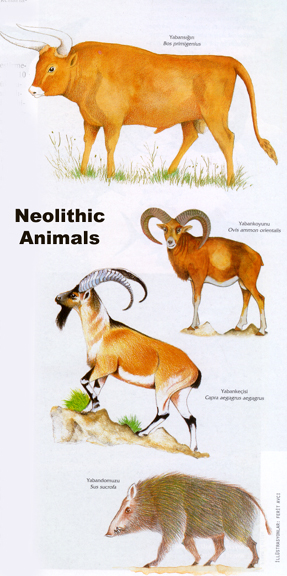
such as emmer wheat and barley, and animals such as pigs, sheep,
goats, cows, --
to extend along a broad band from the Mediterranean to central Asia, this being
the global area where they naturally occurred. In fact, two thirds of the 50-60
cereals and grasses that can be domesticated occur naturally somewhere in
western Eurasia, whereas, only 6 grow naturally in east Asia, and only 2 in
Australia and South America. Of the 14 domesticable
animals that survive on the globe (out of a possible 148 species), nine resided
in the Near East, whereas, only 1 (the llama) existed in south America, and
none at all in North and Central America, Australia, or sub-Saharan Africa. The
north-south trending alignment of Africa and
the Americans played a role in this. Natural and environmental barriers
prevented the spread of domesticable plants and
animals along the lengths of these continents. Without human help animals
simply could not migrate across extensive environmental terrain harmful to
their survival. Moreover, from an
agricultural standpoint progress in Africa and
in other equatorial climates was impeded by obstacles such as poor soil
conditions (owing to a lack of frost that selectively enforces dormancy on
pests, parasites, and disease vectors and aids in topsoil formation) and
labor-crippling diseases such as malaria. From an agricultural standpoint some
regions of the globe have clearly been blessed with greater advantages in this
regard than others.
Nonetheless, the highly
Eurocentric character of archaeological research should not be allowed to
disguise the fact that rising sedentism and
adaptation to the domestication of plants and animals was a global phenomenon.
As the modern climate took root, human elements worldwide were compelled to
accept new subsistence strategies entailing sedentism.
In this respect the decline in climatic variability played a formative role in
the development more settled societies. Agriculture simply could not be
achieved in a Pleistocene climate characterized by intense variability.
THE FIRST CITIES
Farming in the foothills of
neighboring mountains was largely dependent on patterns of rainfall, the limits
of which tended to restrain carrying capacity. As soil nutrients became
depleted, farmers tended to move to more productive terrain, by employing an
environmentally destructive "slash and burn" strategy of land
clearance. As sedentism took root unique confluences
of resource, climate, and location enabled dense populations bordering on urban
societies to develop. Two Ancient Near Eastern communities in particular vie
for the title of the earliest cities on the globe, Jericho
in Israel and Chatal Huyuk in Anatolia.
Jericho
was situated below sea level in the
extremely arid environment of the Dead
Sea Valley
where a large spring opens onto the valley furnishing a lush environment for
wild grasses. Today it survives as a mound some 8m tall and 80m across.
Elements of the Natufian culture first saw the
advantages of this site but quickly abandoned it, probably during the coldest
phase of the Younger Dryas. Around 8000 BC a permanent settlement of perhaps
12000 inhabitants developed on the site. Although they remained predominantly
hunter gatherers they clearly experimented with agricultural production of
wheat, barley, lentils, and chickpeas in the watered vicinity of the spring.
The culling of male animals from herds (as indicated by remains of animal
bones) points to the domestication of animals as well. The scale of this site
and evidence of imported wealth (obsidian, turquoise, cowrie shells) clearly
set Jericho
apart from other communities emerging throughout the region. Their wealth and
prosperity apparently earned the inhabitants unwelcome attention. Before 7000
BC they constructed a massive wall around their town some 3m wide at base, 4m
tall, and 215m in circumference. At one end of the bastion stood a tower three
stories tall. Surrounding the wall was a moat 9m wide and 10 ft deep. Although
some have argued that the purpose of these structures was flood control, the
location of this wealthy settlement, situated as it was along one of the main
migration routes of the Ancient near East, appears to exposed it to repeated
attacks of invaders, compelling its inhabitants to engage in the massive
defensive construction that have survived. (Olson, 97)
Chatal Huyuk (7300-6200 BC) survives as a mound some 32 acres
broad situated on the flat plain of the Anatolian plateau about 30km south of
modern day Konya.
To sustain themselves the estimate 5000-6000 inhabitants practiced cereal
farming and sheep and goat herding as well as hunting in nearby plains. They
constructed flat-roofed mud brick houses in tightly arranged circular rows that
possibly offered a means of defense. Access to the houses was obtained through
apertures adjacent roofs. Evidence of stone knapping seems to have been
ubiquitous throughout the site, indicating that the inhabitants fashioned
blades and tools from obsidian obtained from nearby mountains. Since these
artifacts have emerged in archaeological assemblages as far removed as Israel, this
activity seems to have played a formative role in the development of this
community. Most significant among the archaeological findings is the widespread
evidence of religion inside the dwellings. Clay figurines of female goddesses
call to mind the Venus figurines of Gravettian
culture. A shrine adorned with bulls' heads points to the existence of
organized cultic activity.
Jericho and Chatal Huyuk offer crucial signposts to the transitions underway
in Neolithic cultures. Sedentism and domestication of
plants and animals enabled societies to develop into food producers as opposed
to food gatherers. Food production inevitably led to surpluses capable of
sustaining populations through fallow winter months; stable food supplies also
enabled populations (or some elements thereof) to focus on activities unrelated
to food production, such as obsidian production for export purposes at Chatal Huyuk. Other innovations
such as weaving, ceramic production (wheel turned pottery by 6000 BC,
metallurgy (copper tools by 5000 BC), rapidly followed. Theorists argue that
several additional cognitive and physiological innovations occurred during this
transition as well. Since a family of four consumes essentially a metric ton of
grain/year the need for food storage facilities became similarly important and
possibly helped to stimulate concepts of ownership and private property.
Similarly settled agricultural existence arguably altered gender roles.
Abundant food supplies and sedentary lifestyles possible raised levels of
female body fat, thus shortening the time between pregnancies. Since increased
pregnancies produced more labor for farm work this change was probably viewed
as advantageous by emerging farmers. However, the evidence also indicates that
it led to higher overall maternal mortality.
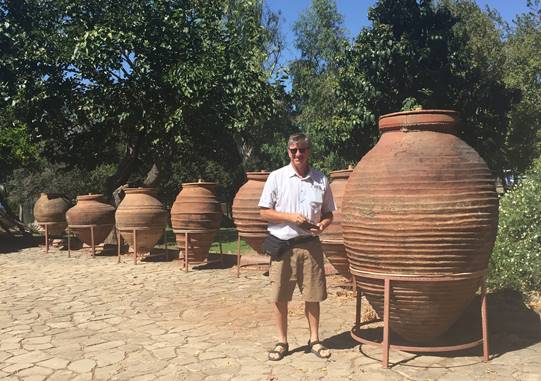
Pithoi, Large Grain Storage Jars, Antalya Museum
It remains important to
recognize that the Neolithic Revolution
marks a transitional phase in human existence, not an era. It occurred first in
the highlands of Mesopotamia c. 9000-7000 BC.
The technology then radiated outward to neighboring regions. It did not occur
on the Nile River
in Egypt
until c. 5000 BC. The Indus/ Ganges River cultures adapted to agriculture c.
7-6000 BC, the Yangtze (Yellow) River settlements in (China) devised a
rice-based agricultural technology independently c. 5000 BC. Rise of
agriculture in Britain did
not occur until 2000 BC; in Australia,
1000 AD. In South America, Neolithic culture
emerged totally in isolation by 5000 BC. The date of this development would
seem to point to necessity (possibly as a result of climate change) as the
engine to human adaptation to agricultural technology world wide before 5000
BC. Bronze metallurgy arose by 3500 BC. Bronze Tools, in turn, facilitated
riverine cultures consisting of large dense settlements
USEFUL BIBLIOGRAPHY
AL Bloom, Geomorphology
a Systematic Analysis of Late Cenozoic Landforms (Prentice Hall, 1998
W. J. Burroughs, Climate
Change in Prehistory: The End of the Reign of Chaos. Cambridge, 2005
J. Diamond, Guns, Germs,
and Steel, The Fates of Human Societies, ny,
Norton, 1997
Steve Olson, Mapping
Human History: Genes, Race and our Common origins: Boston, NY,
Houghton Mifflin/mariner, 2003
R. J. Wenke,
Patterns in prehistory. Humankind's First 3 Million Years. 4th ed., Oxford, 1999