Chapter 5: The Bronze Age Near
East
As noted in the previous
chapter around 5000 BC, sustained agricultural settlement arose globally,
particularly in broad flat river valleys where large scale irrigation projects
were possible. Following the invention of technologies such as ceramics,
weaving, and textile production (the mastery of all of which occurred by ca.
6500 BC), metallurgists in the region of Mesopotamia generated bronze tools
around 3500 BC. Bronze is achieved through the mixture of small amounts of copper,
tin, arsenic, and other metals with low firing temperatures to form a brittle
but hardened metal capable of holding its edge. The molten metal could be
poured into open or closed molds to make tools and weapons, or simply hammered
into sheets for later processing. The invention of bronze tools revolutionized
laboring activities, most significantly, farming. This enabled settled
agricultural communities to harness the rich alluvial soils and abundant water
of river basins such as the Tigris and Euphrates in Mesopotamia. The ensuing
era is known as the Bronze Age
(3300-1100 BC), and the large urban societies that emerged in riverine
environments at this time are often referred to as hydraulic
civilizations. As opposed to dry farming techniques employed in the
surrounding highlands, farmers settling in river valleys had the advantage of
harnessing their water supply by trapping and storing floodwaters for sustained
use in crop production. The inhabitants of Mesopotamia, for example, learned to
conserve flood waters by opening networks of canals along the Tigris and
Euphrates Rivers (approximately 50 km apart in central Iraq). The vestiges of
these vast canal networks remain visible today in aerial and satellite
photography.
Flooding in Mesopotamia
tended to occur in two phases, the first was generated by winter rains in the
distant mountains of Anatolia, the second phase came
with the spring snow melt in the same highlands. Given the fact that the
origins of flooding events lay far beyond the horizon of Mesopotamian
settlements, the flooding appeared to the inhabitants to arrive violently and
unpredictably. The natural topography of the river plains compounded the challenge
– large meandering rivers tend to build up natural levies that gradually lift
the level of the river above that of the surrounding flood plain. Early
settlers learned to tap these levies to direct water onto neighboring lowlands.
However, during surging floods the rivers themselves could breach the levies
and forge new channels across farmland and settlements, causing extensive
damage to man-made landscapes. Sudden adaptation to changing circumstances was
necessary, therefore, and helps to explain the frequent relocation of
settlements in Mesopotamia. Otherwise the climate had little to recommend. The
land between the rivers presented itself as a hot, dry, mostly flat, seemingly
barren stretch of desert. Natural resources such as stone, timber, or metals
were nonexistent and needed to be imported from neighboring regions.
Mesopotamia's chief natural resource, the deep layers of soil deposited by the
rivers at the end of the Ice Age, served multiple purposes. By means of
irrigation the earth furnished abundant food supplies. Through the adaptation
of frame-formed, sun-dried mud bricks it furnished an essential construction
material. And through its flat, open terrain it offered mobility - essentially
an open highway - to assorted peoples who migrated into the region. In
addition, the terrain beyond the river basin rose into low hills and valleys
that furnished grazing land for herders who could supplement agricultural food
production with abundant livestock. The inhabitants of Mesopotamia thus
produced ample surpluses of food, principally grain, but a host of garden crops
as well, enough to sustain an estimated population of 1-2 million people by
Roman times. With temperatures attaining 140˚ F. during the summer months,
the climate can best be described as daunting. Shade furnished by date palm
trees, lush canal-fed gardens and mud brick domestic quarters, not to mention
abundant food and water, made life bearable.
As we saw in Chapter One, the
region of the Fertile Crescent functioned as a major crossroads for migratory
peoples. By the time populations became sedentary a diverse array of human
cultures coexisted (and competed) within its horizon. Dry farming techniques
(those relying principally on rainfall) remained the norm in northern
Mesopotamia and along the hillscape of the wider
region of modern day Iraq, eastern Turkey, western Iran, and Syria. Crop yields
tended to be lower in these regions making it necessary to cultivate larger
areas to feed populations equivalent to those employing irrigation techniques
in basins to the south. Numerous cultures took root along a wide arc extending
from the Mediterranean coast to the Persian Gulf. In chronological order these
were Hassuna Culture (6000-5500 BC), Samarra Culture
(5600-5300 BC), and Halaf Culture (5500-4800 BC). Hassuna culture was characterized by small village enclaves
of 100-200 inhabitants who resided in houses framed around central courtyards.
Finds of Hassuna styled painted wares help to map the
spread of this culture across northern Mesopotamia. Samarra culture displayed
imported grave goods (turquoise, carnelian, copper); its inhabitants cultivated
flax for clothing, produced olive oil for diet, fuel, and personal hygiene, and
they experimented with irrigation techniques. They used sun-dried mud brick to
build rectangular houses with buttressed walls, communal storage facilities
that resemble later Mesopotamian temples, and earthen defenses. Halaf culture extended over a much wider area than either
of the preceding cultures and attributes such as a return to circular houses
suggest that it was imported by new comers to the region later known as
Assyrians. Halaf people manufactured spectacular
ceramic wares -- hard fired, finely turned, brightly painted, and intricately
decorated with geometric patterns and designs. Since the distribution of these
wares extended far beyond their region of production, the culture clearly
attained levels of complexity necessary to accommodate professional potters and
long-distance trade. In general the more dispersed rural populations of this
region tended to generate secular rather than priestly hierarchies. Tribal
chieftains and kings residing in fortified palaces came to dominate the urban
landscape of northern Mesopotamia.
In the south where urban
civilization would first emerge, geological evidence indicates that the sea
level ceased to rise around 5000 BC, causing the mouths and estuaries of the
great rivers to silt in. This impeded natural drainage and formed a large area
of inland lagoons and marshes. As the climate became drier, communities adapted
to small scale irrigation in areas where water tables were high. Crop yields
rose dramatically. Mesopotamian texts dated to 2100 BC record yield to seed
ratios of 30:1 and even 50:1. With the advent of bronze tools around 3500 BC,
the labor intensive aspects of irrigation work became more manageable,
stimulating the rise of urban settlements.
Archaeological investigation
indicates that the process of urbanization in southern Mesopotamia began as
early as 5800 BC, with several large centers of population arising by 4300 BC.
Ubaid culture (c. 5500-3700 BC) in southern Mesopotamia was contemporary with Halaf culture in the north. Already by 4500 BC the
settlement at Eridu is estimated to have accommodated
2000 to 4000 inhabitants. It is important to note that excavations at Ubaid
sites such as Eridu have yet to reach the earliest
levels of human occupation, raising the possibility that Ubaid culture actually
predated those to the north. Ubaid settlements typically consisted of much
larger villages (ca. 750 residents) whose inhabitants resided along the river
banks in houses constructed of reed and mud brick. Unlike settlements in
northern Mesopotamia, Ubaid settlements tended to cluster around religious
complexes, temples with altars for burned offerings erected on raised mud brick
platforms. Given the limited durability of unfired brick (which weather in
about a century), these platforms had to be repeatedly refashioned. The
remodeled complexes were typically built over the remains of earlier
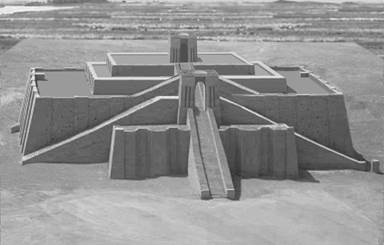
structures, gradually forming step-like raised platforms known as Ziggurat. At
the Ubaid settlement of Eridu, for example, the
ziggurat was rebuilt on the same location for more than 1000 years. Since these
monuments assumed central positions in Ubaid settlements, they most probably
functioned as regional ceremonial centers, organized and controlled by local
hierarchies of priests. Early Sumerian texts demonstrate that many of these
cities were ruled by priest kings known as ens. Many settlements also exhibited large
centrally located storage facilities, suggesting that the priest kings
controlled the community’s capacity for food storage and redistribution.
Neighborhoods of socially stratified inhabitants (based on house size and the
range of burial gifts) emerged around these complexes.
Ziggurat at Ur; Illustration
by John Hill
By 4700 BC Ubaid culture
expanded outward to replace Halaf culture in northern
Mesopotamia, neighboring Iran, Arabia, and the Persian Gulf. By the so-called
Early Dynastic Period of Sumer (3100-2700 BC), some 89% of the population of
southern Mesopotamia lived in communities of 100 or more acres. According to
survey investigations, between 4500 and 3000 BC the number of villages in
southern Mesopotamia increased from 17 to 124, towns multiplied from 3 to 20;
and small urban centers from 1 to 20. The population of Uruk
attained an estimated population of 50,000 and several other cities grew to the
range of 20-30,000. In addition to ziggurats their inhabitants constructed
massive fortification walls for enhanced security. As cities grew they
incorporated older villages and towns into urban-centered economic and
political complexes, a process often referred to as an urban revolution. As urban settlement increasingly became the norm,
it is essential to bear in mind the physical and social distinctions that
emerged with the dry farming settlements to the north, not to mention those of
nearby tribally organized pastoral groups that exploited the wastelands of the
Mesopotamian desert to raise livestock. These last elements lived in close
proximity to the emerging cities and traded their yields for tools and
equipment. Mobile, highly autonomous pastoral populations, typically self-identified
as tribes, remained a permanent fixture on the Near Eastern landscape. Other
scattered populations cut timber and quarried rock and metal ores in
neighboring mountains such as the Tauros Mts. in
southern Anatolia and the Zagros Mts. in Iran. To the east of Sumer Elamite
civilization (to be discussed below) emerged at Anshan and Susa, exhibiting the
same urban features as Sumer and exporting these to the highlands of the
Iranian plateau. Still other populations in places later known as Dilmun
(Bahrain) and Magan (Oman) maintained fishing
settlements, smelted copper, and gradually invented means of maritime
transportation along the shores of the Persian Gulf. Through their intermediacy
Mesopotamian populations made contact with those in the Indus valley (Meluhha). As the wider regional distribution of Halaf and Ubaid pottery demonstrates, the production of
food surpluses along the river basins stimulated ancillary activities over an
extended radius.
Historical Outline of Bronze Age Mesopotamia,
3300-1100 BC
Writing technology was
achieved in Sumer by 3100 BC, enabling us to obtain a better grasp on
developments and events. Although we will discuss the character of this
technology below, for the moment a basic outline of Bronze Age history becomes
essential. The array of Bronze Age chronological systems tends to bewilder the
uninitiated. Their complexity largely arises from the fact that early
archaeologists working locally throughout the Near East devised idiosyncratic
dating systems without the benefit of coordination. In addition, recent
dendrochronological and astronomical evidence has indicated that the
convention chronology for the Bronze Age Near East (what is now known as the
Middle chronology) is off by about a century beginning in the second millennium
BC. In broadest terms, scholars tend to characterize Bronze Age Near Eastern
history in three phases: Early Bronze Age (3100-2100 BC), Middle Bronze Age
(2100-1600), and Late Bronze Age (1600-1200). These approximate phases are of
course subject to dispute, but they do tend to map a pattern of ebb and flow in
the development of Bronze Age world-systems to be considered in the following
pages.
CHRONOLOGY 2: Bronze Age World Chronology
Ø Early Bronze
Age 3100-2100 BC
Ø Middle Bronze
Age 2100-1600
Ø Late Bronze
Age - 1600-1200 BC
Bronze Age Near Eastern Chronology
Ø Pre-Dynastic
Sumer: Uruk Phase 3700-3300; Jemdet
Nasr Phase 3300-3000
Ø [Early Bronze Age 3100-2200]
Ø Early
Dynastic Sumer 3300-2300 BC (Death Pit at Ur, 2600 BC)
Ø Akkadia 2300-2150
(Sargon the Great, 2334-2279 BC, Naram-Sin
2190-2154)
Ø Climate
flicker - Akkadian regional collapse 2150 (Collapse of Old Kingdom Egypt 2180)
Ø Third Dynasty
of Ur 2119-1940
Ø Early Bronze
Age Regional Collapse ca. 1940-1750
Ø [Middle Bronze Age 2100-1600]
Ø Rise of
Assyria, Babylonia, and Mari ca. 1800
Ø Hammurabi's
Babylonia ca. 1792-1750 (dynasty lasted until 1590)
Ø Middle Bronze
Age Regional Collapse ca. 1600-1500; More Invasions, Hurrians,
Kassites, Mitanni (Indo-Europeans) (Collapse of
Egyptian Middle Kingdom, ca. 1720; Hyksos Invasions) Minoan destruction c.
1600)
Ø [Late Bronze Age 1600-1200 BC]
Ø Competing
Territorial States, Mitanni (1600-1400), Assyria (1800-through end of Bronze
Age) and Kassite Babylonia (1600-1200), New Kingdom Hittite Empire (ca.
1400-1100), New Kingdom Egypt (1550-1070), the Mycenaeans
(1600-1200 BC)
Ø Collapse of
Late Bronze Age world system ca. 1200-1000 BC
During the Early Bronze Age
the chief cultural unit in Mesopotamia was the independent, autonomous city
state with its surrounding hinterland of irrigated agricultural terrain. As
many as twenty of these existed in southern Mesopotamia by the Early Dynastic
Period (3300-2300 BC). However, written sources such as the Sumerian Kings List (ca. 1900 BC)
indicate that by the 2700 BC neighboring city states in Sumer were increasingly
embroiled in conflict. Within each Sumerian city a military leader known as a lugal supplanted the en and essentially eliminated any
prior distinction between secular and religious authority. Competition and
military rivalry among city states gradually forced inhabitants to accept the hegemonial authority of individual lugals over increasingly larger
territory. This authority was rationalized in the Kings List as a process of
divine selection -- only one divinely legitimized ruler could exist at a time,
and the selection was restricted to a handful of ruling houses. The result was
a gradual development of extraterritorial states or empires. Although the early
parts of the Sumerian Kings List were plainly legendary (with reigns of kings
extending hundreds if not thousands of years), the accuracy of later parts of
the list are corroborated by externally dated texts. By 2700 BC, for example, Lugal Emmerbaragesi of the city
of Kish overwhelmed his neighbors to establish a wider hegemony. His example
was followed by Lugal Gilgamesh of Uruk (ca. 2500 BC), Lugal Mesannepadda of Ur (ca. 2600), Lugal
Eannatum of Lagash (2450-2360), and Lugal Zagesi of Umma (2360-2350). As regional authorities the lugals continued to recognize the legitimacy of neighboring
communities and to respect the authority of associated patron deities. Despite
remaining a militarily insignificant community, for example, the priests of
Nippur enjoyed inordinate status due to the importance of the town’s patron
deity, the chief god of the Sumerian pantheon, Enlil. The priests used this
authority to demand and to obtain regional contributions to support the cult of
Enlil and on occasion to mediate boundary disputes between neighboring states.
By extension they maintained the right to anoint, and thus to legitimize a
regional lugal. Successful kings such as Sargon of
Akkad (2334-2279 BC) responded to these circumstances by designating relatives
to preside over the cult of Enlil as well as those of other Sumerian patron
deities.
The architecture for
Mesopotamian hegemony was first crafted by this last mentioned king, Sargon of
Akkad, who rose allegedly from humble origins to assume the office of royal
cupbearer to the king of Kish. He then usurped the throne, defeated neighboring
rivals, and claimed authority throughout Sumer. He built a new capital for
himself at Akkad, believed to lie beneath the modern city of Baghdad. After
defeating the Elamite king of Anshan (and establishing a provincial
headquarters at Susa), he marched northward along the Euphrates, conquering
other important settlements such as Mari and Ebla and pushing all the way to
the Tauros Mts. Sargon exerted forceful control over
subject populations, demolishing the defenses of rebellious communities,
removing and replacing local kings with personally appointed governors (who
received the title of ensi).
He appointed relatives such as his daughter Enheduanna (2285-2250
BC) to important priesthoods throughout the realm. Outside Sumer he enslaved
conquered populations and expropriated their lands. He forcibly relocating
prisoners to work areas in distant regions of the empire and distributed land
allotments to warriors recruited from unruly pastoral elements. One inscribed
document records that he dined regularly with 5400 such retainers. He extended
trade lines from the Mediterranean in the west to the Indus and the Oxus
valleys in the east, opening up exchanges of bitumen, agricultural produce, and
textiles for gold, silver, copper, lead, stone, timber, spices, and resins. The
Akkadian dynasty had its ups and downs; both Sargon and his successor had to
suppress coordinated rebellions. His grandson Naram
Sin (2190-2154 BC) eventually reasserted Akkadian supremacy throughout the
region and assumed divine status, boasting that his rule extended to the
"four corners of the earth.” The Akkadian dynasty thus established a model
for Near Eastern empire building that would be imitated for centuries.
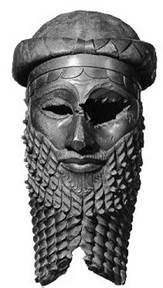
Head of an Akkadian ruler, from Nineveh (modern Kuyunjik), Iraq, ca. 2250-2200 BC; Copper, 1’ 2 3/8” high;
Iraq Museum, Baghdad
Shortly thereafter, the
Akkadian Empire collapsed and along with it the trade links of the wider world
system. Contemporary sources blamed this on the invasion of a migrating people
called the Gutians who probably originated in the
Zagros Mts.; however, the extent of the disturbances appears to have been much
wider and far more significant. Not all constituent societies were affected in
the same manner or at the same time. In Sumer a hierarchy known as the Third
Dynasty of Ur (2119-1940 BC) was able to flourish for at least another century,
commanded by two notable kings, Ur Nammu (ca.
2047-2030 BC) and Shulgi (2029-1982 BC). However,
this too collapsed amid crushing conflicts with the Elamites and with
semi-pastoral elements known as the Amorites. The last king of Ur actually
attempted to construct a defensive line of fortifications between the Tigris
and the Euphrates rivers to stem the tide of these intruders. The Semitic
Amorites seem either to have migrated into Mesopotamia around 2000 BC -- driven
by disturbed conditions elsewhere -- or to have dwelled there all along.
Regardless, they were now becoming increasingly troublesome. Bronze Age
societal collapse also occurred at this time (ca. 1900 BC) in the Indus Valley
(Harappan Civilization), suggesting that this too was
somehow connected to the overall pattern. Likewise, a sustained thousand-year
era of stability in Old Kingdom Egypt came to a close (2100 BC) amid reports of
lowered river volume and famine in the Nile Valley. Settlements in Palestine
and the Negev likewise exhibit evidence of destruction ca. 2200 BC, followed by
abandonment for nearly two centuries. Even agro-pastoral peoples beyond the
immediate horizon of the Near East appear to have been set in motion at this
time. Indo-Europeans dwelling in the steppes north of the Black and Caspian
Seas migrated into Greece ca. 2200-2000 BC (where evidence of destruction is
less significant but material contexts show dramatic changes), as well as into
Anatolia (where survey data indicates a 75% decline in settlement occupation)
and the Caucasus. Culturally related Indo-Iranians or Aryans migrated from the
same region into Central Asia (where they possibly conveyed their agro-pastoral
lifestyle to the Oxus River civilization ca. 2200-1700 BC), the Iranian
plateau, and the Indus Valley (arriving by 1700 BC). Another element known as
the Hurrians moved from the highlands of eastern
Anatolia (modern day Armenia) into northern Mesopotamia to play an influential
role in the following era. A combination of accumulating textual and
archaeological evidence demonstrates, accordingly, that something dramatic, if
not transformative, occurred at the close of the Early Bronze Age.
Many researchers associate
the occurrence of so many contemporary disturbances at the end of the Early
Bronze Age with a prolonged period of climate change that appears to have
induced widespread and sustained phases of drought ca. 2200 to 1900 BC.
Geological and textual data for this has accumulated throughout the region.
Sediment cores reveal evidence of low water tables in regional rivers (the
Tigris, Euphrates, Nile) ca. 2100-2000 BC, and similar soil samples obtained in
Oman exhibit significant concentrations of windborne silt originating from
Mesopotamia ca. 2000 BC. Since surviving Sumerian texts record evidence of
skyrocketing grain prices, the extreme drought conditions potentially impacted
agricultural yields even in the irrigated lowlands. Failing food production
throughout the affected regions possibly induced famines, disrupted trade
lines, and set fringe populations into motion. In this regard the chaos
provoked by the movement of severely affected inhabitants of dry-farming and
pastoral terrain along the margins of Mesopotamia to the irrigated fields of
the river basins may account for the widespread rebellions that weakened the
Akkadian empire. Regardless of the validity of the climatological explanation,
the general pattern of gradually expanding interconnectivity visible in the
Near East during the third millennium BC came to a halt. When urban societies
reemerged shortly afterward, their complexion was dramatically altered in most
if not all affected regions.
During the Middle Bronze Age
(2100-1600 BC) the earlier urban states of Sumer remained core repositories of
religious authority, agriculture, craft production, and knowledge, but
political authority gravitated increasingly toward emerging polities in central
and northern Mesopotamia such as Babylonia (ca. 1700), Assyria (ca. 1800), and
Mari (ca. 1800) as well as to the powerful regional polities of Elam (Susa and
Anshan) to the east. Amorite warrior chieftains assumed control of numerous
communities throughout the region, including Sumer. Several of these emerged as
kings of comparably sized states to compete for regional domination. Despite
their pastoral origins these dynasties assimilated the prevailing urban
attributes of the region and became indistinguishable from their Sumerian
neighbors, even as additional non-sedentary peoples, such as the Hurrians and Kassites (from the
Zagros Mts.), infiltrated the basin. In general, states were larger in this era
and incorporated numerous villages and city states within their territories.
Hammurabi (1792 - 1750 BC), the king of a small and previously unimportant city
of Babylon, ultimately defeated his rivals to impose a brief tenure of world
order comparable to that of Akkad and Ur III during the previous era. We will
discuss the significance of Hammurabi’s celebrated law code below. Although
Hammurabi’s dynasty persisted for 150 years, its control of the region proved
tenuous and his empire began to unravel following the death of his son Samsu-iluna (1686-1648 BC). Simultaneously, emerging powers
just beyond the horizon began to target the stored riches and resources of
Mesopotamia by marauding the region with devastating effect. The Hittite King Mursilis I (1620-1590) invaded Mesopotamia from central
Anatolia around 1600 BC, destroying Mari and neighboring polities in the north
and sacking the capital of Babylon. His sizeable army was spearheaded by
squadrons of horse chariots, an emerging technology from Central Asia that
would revolutionize military tactics in the coming era. The consequences of
this momentary razzia ushered in a century of
political confusion throughout the region.
Although the overall
chronology of Middle Bronze Age developments remains disputed, the Hittite
campaign in Mesopotamia is increasingly recognized as a second marker for
system-wide societal collapse. Once again polities throughout the region
underwent transformation as interregional connectivity subsided. The Hittite
King Mursilis I returned to Anatolia in triumph only
to be assassinated in a palace coup, thereby, plunging his realm into a century
of political disturbance. These difficulties were compounded by evidence of a
plague that his army contracted during the invasion. Hittite records indicate
that the plague persisted in Anatolia for many decades. Similar reports of
plague were recorded in Syria, Mesopotamia, and Egypt, leading to the suspicion
that a regional pandemic possibly occurred. Meanwhile, political hierarchies
collapsed throughout the region. For example, the Egyptian Middle Kingdom
(2100-1750 BC), which had become increasingly engaged with neighboring
communities along the eastern Mediterranean coast, relinquished control of its
crucial delta region to an influx of Semitic peoples referred to as the Hyksos.
For nearly two centuries Hyksos kings based at Avaris
at the Nile Delta directed the flow of prestige goods in and out of the Nile
basin, diminishing the power of native Egyptian hierarchies in Upper Egypt.
Between 1700-1600 BC palace-based Bronze Age communities in Minoan Crete
experienced a rash of cataclysms, some possibly the result of conflict, but
others apparently induced by natural disasters such as a conjectured earthquake
storm (a wave of successive earthquakes) followed by a powerful volcanic
eruption at the nearby island of Thera. The latter event, carbon dated to 1600
BC, emitted four times the seismic energy of the eruption of Mt. Krakatoa in
1883 AD, the greatest known volcanic eruption of modern times. Although Minoan
inhabitants survived this event and eventually restored their communities, the
disturbances appear to have enabled neighboring Mycenaean hierarchies on the
Greek mainland to supplant Minoan influence throughout the Aegean. In a similar
manner following the sack of Babylon, Hurrian warrior elites, many of them
bearing Indo-European names, filled the vacuum created by the Hittite invasion
in 1600, along with the Assyrians and the Kassites,
the last of whom seized control of Babylon. As the Mitanni, the Assyrians, and
the Kassites, these hierarchies would dominate
Mesopotamia and become recognized parties of the international ruling order
that controlled the Near East during the era of the Late Bronze Age.
Several additional features
about the Middle Bronze Age appear noteworthy. First, the chronology of the
Middle Bronze Age was shorter than the Early Bronze Age (approximately 500
years as opposed to 1000), as was its duration of collapse, depending on the
region. In this instance apart from the eruption of Thera there is no
significant evidence that climate change induced system-wide collapse. Instead,
societal ebb and flow during the Middle Bronze Age appear to have resulted more
directly from anthropogenic forces. Second, the era could more accurately be
described as one dominated by regional polities – Assyria, Mari, Babylon, Sealand, Elam, Minoan Crete, Mycenaean Greece, Hittite
Anatolia, Canaan, and Egypt – as opposed to city-states or larger empires like Akkadia or Ur III, the brief hegemony of Babylon
notwithstanding. Few rulers during the Middle Bronze Age presumed to refer to
themselves as god kings, as Naram Sin and the
Pharaohs of Old Kingdom Egypt had done during the previous era. Expectations
seem to have been substantially lowered. Third, the flow of communications
during the Middle Bronze Age appears to have shifted away from the Persian Gulf
and toward the basin of the Mediterranean Sea. Prestige goods undoubtedly
continued to flow along the first mentioned water way, but major polities such
as Harappan civilization in the Indus Valley
collapsed by 1900 BC, leaving the political lines of material transfers more
difficult to follow. In the eastern Mediterranean basin, meanwhile, the royal
dynasties in Middle Kingdom Egypt became actively engaged with neighboring
communities, trading surplus resources from the Nile for timber, wine, and oil
from Canaanite cities such as Byblos and Ugarit. With the advent of sea-going
cargo ships in this era urban societies in Cyprus, Cilicia, and Crete began to
ship resources to the Near East in increasing volumes, with the result again
that older societies increasingly looked westward for staple and exotic goods.
In short, a much wider radius of urban states came into existence during the
Middle Bronze Age, and the volume of extra-regional exchanges continued to
expand. Instead of empire building the polities of the Middle Bronze Age appear
to have concentrated on developing local resources, maximizing agricultural
output, and expanding urban landscapes within their respective territories.
Material transfers were secured more through negotiation and diplomacy than
through outright conquest. Undoubtedly, the objective was to develop the means
necessary to acquire foreign prestige goods and to compete militarily with
neighboring powers, but these efforts, for the most part, proved transitory. At
the same time, mobile foreign elements, such as the Hurrians,
Indo-Europeans, Kassites, and Hyksos, simultaneously
infiltrated the perimeters of developing principalities to pose significant
military distractions. On the one hand, these new comers infused the
established societies with additional laboring power and new technologies such
as the horse chariot and the compound bow. On the other hand, they destabilized
regional hierarchies by virtue of their growing and unruly presence. As a
result, the Middle Bronze Age in the Near East resembled a transitory period in
which newly developing cultures absorbed and assimilated the legacy of the
previous era while expanding the dominant urban lifestyle of the region and
harnessing the available resource capacity of their immediate vicinities. This
dynamic grass-roots investment ultimately laid the foundation for the powerful and
more sustainable civilizations that would emerge during the Late Bronze Age
(1600-1200 BC).
The Late Bronze Age
(1600-1200 BC) was characterized by a new, much broader, and more highly
integrated network of world powers than in either of the previous two eras.
Large imperial hegemonies such as the New Kingdom of Egypt, the Hittite Empire
of Anatolia, the Mycenaean Civilization in the Aegean, and the Mitanni,
Assyrian, and Kassite realms in Mesopotamia engaged in close economic and
political communication throughout the period. The hierarchies of these empires
displayed a remarkable degree of diplomatic correspondence, crucial vestiges of
which survive. In each principality, royal chancelleries administered a
constant flow of messages with their counterparts abroad, typically in Akkadian
cuneiform. Trade between these realms was significant and likewise directed by
royal bureaucracies. Treaty relations and marriage alliances between dynasties
were commonplace, as rival powers attempted to forge alliances, intimidate
neighbors, and achieve a balance of power. Since displays of force were
likewise necessary to secure territory and to assert boundaries, the primary
expenditure of each competing hierarchy went to the military. Rival kings
conducted repeated military campaigns with sizeable armies spearheaded by
squadrons of horse chariots. Each king attempted to expand his territory by
picking off the border states of his neighbors. These exercises culminated in
the greatest military event of the era, the Battle of Kadesh in 1274 BC,
between the forces of the Hittite King Muwatallis II
and King Ramses II of New Kingdom Egypt. Some 40,000 chariots and 80,000
infantry reportedly fought to a standstill on the plains of western Syria
during this clash. The Late Bronze Age world system persisted until
approximately 1200-1100 BC when widespread, even catastrophic collapse affected
the entire region, from the Greek mainland to Egypt, Anatolia, Canaan, Syria,
Mesopotamia, and beyond. The records of this era and the events, the societies,
and the personages they record are so detailed that they warrant particular
attention in the chapters that follow. In the meantime, a number of details
presented above require explanation, including the cultural attributes of Early
and Middle Bronze Age societies, the nature of early written records, the
economic and social organization of Near Eastern societies in general, and the
status of their inhabitants, especially women.
The Cultural Attributes of Ancient Mesopotamian
Populations
The historical outline
presented above raises a number of issues that require sorting out. First, we
need to identify as best we can the cultural distinctions that separated the
Sumerians from neighboring peoples such as the Elamites, the Akkadians, the Assyrians,
the Amorites, the Hurrians, the Gutians,
and the Kassites. To do this, one must inevitably
resort to language distinctions, at least insofar as they are used to identify
cultural heritage. Invariably when investigating early historical societies scholars
rely on linguistic tools. It is important to recall that culture remains an
artificial construct, slowly developed through human experience and preserved
through recursive memory. People of different ethnic or racial backgrounds can
be taught to speak the same language. One must avoid confusing culture and
ethnicity in what follows.
SIDEBAR: DECIPHERMENT OF CUNEIFORM, the Behistun
Inscription
We owe our understanding of the cuneiform script to
Sir Henry Rawlinson, a British diplomat and classicist who carefully recorded
three inscribed texts of the royal inscription of king Darius I of Persia at Behistun in 1838. The accomplishments or Res Gestae of the
Persian emperor, Darius i were inscribed in three languages; in Babylonian (Akkadian),
old Persian, and Elamite, below a relief portraying the king paying homage to
the Iranian deity Ahura Mazda. The relief and
inscriptions were recorded on a cliff face of a large mountain at the gate to
one of the passes leading from Mesopotamia into Iran. At considerable risk to
his own person Sir Henry Rawlinson allegedly scaled the face of the cliff using
rope and planks to carefully transcribe the inscribed texts. Rawlinson and
others were able to use the knowledge of Persian Sanskrit to decipher the
cuneiform version of the text.
Cuneiform Writing Technology
Although the precise origins
of the Sumerians remain uncertain, they were the first to develop an urban
civilization complete with a written language. The Sumerians devised a system
of writing based on wedge-like characters that were impressed on clay tablets
with a reed stylus. Hence, the Latin, cuneiform,
"wedge-like characters." These were inscribed on a number of writing
implements, including clay tablets, cylinder seals, and bullae (stamped lumps of clay used to seal documents). The earliest
known written texts were found in Uruk and date to
ca. 3600-3500 BC. They amount to little more than temple inventories detailing
the assets, the labor force, and the stored resources at the disposal of a
priestly establishment. Temple priests attempted to catalogue these resources
using pictographic representations of items such as sheep or measures of grain.
Eventually they were able to create shorthand symbols representing the same.
From these pictographic characters early chroniclers came to the realization
that the symbol for something such as the human foot could also be used as a
measurement or for the action of "walking” itself, and hence, that written
characters could assume more flexible, abstract functions as ideograms (signs used to represent
ideas). In addition, some symbols came to represent the sounds of words or the
ideas they represented. Cuneiform symbols thus became syllabic and could be
used to write any word in the spoken language, including many words that were
impossible to convey through pictures. As a spoken language Sumerian was well
suited for the development of syllabic writing because it consisted largely of
monosyllabic words and contained many homophones (words having the same sound
but different meanings). To avoid confusion scribes added signs called
determinatives to distinguish between similar sounding words. Eventually
hundreds of such characters were devised rendering Sumerian cuneiform a
difficult, highly complex writing technology that required years of training to
master. By 2500 BC most Sumerian cities supported schools knows as edubba, or tablet houses, to train scribes and
officials. Although the day-long regimen of studies was demanding and
punctuated by instances of corporal punishment, the graduates of these schools
rose to become government officials, military officers, sea captains, public
works supervisors, construction foremen, accountants, scribes, and other
professionals. The edubba
thus facilitated the recursive memory of Sumerian civilization, inventing new
systems of learning and culture while preserving and disseminating the
knowledge and traditions of the past. Due to its complexity cuneiform remained
the exclusive property of a limited elite, such as the priestly authorities
mentioned above, and the scribal elements that supported these hierarchies.
Most rulers probably could not read or write cuneiform, for example.
Cuneiform was one of several
competing writing systems to develop in the Early Bronze Age, but it gradually
acquired the most practitioners and thus attained regional ascendancy. The
presence of competing writing systems reminds us, however, that Mesopotamia was
inhabited by a diverse variety of cultures. Most language cultures recorded in
Mesopotamia were present by the end of the Pleistocene era, including several
such as Subarian, Gutean,
Hurrian, and Kassite that appear to have been autochthonous (that is, native to
the region as opposed to having arrived from without). Others (Sumerian,
Semitic, and Indo-European) appear to have originated elsewhere. The capacity
of Mesopotamian resources to sustain expanding populations appears to have
attracted a diverse yet blended population by the Early Bronze Age. Despite
speaking multiple languages the inhabitants of Sumerian cities appear to have
ceased to identify themselves according to tribal or cultural origins. Sargon
of Akkad (2334-2279 BC), for example, was a Semitic speaker but a resident of
Sumerian Kish. Although his father was allegedly a commoner, his mother was a
temple priestess. Hence, the family was fully integrated in Sumerian culture.
As Semitic speaking rulers like Sargon assumed control of urban hierarchies,
they adapted cuneiform script to their own spoken language, known today as Akkadian. To do this, scribes added
phonetic signs behind Sumerian ideograms to indicate that the symbol in
question was meant to be read as an Akkadian word instead of the original
Sumerian. The success of the Akkadian empire, with its implementation of
governors and hierarchies in conquered cities, essentially imposed the Sumero-Akkadian script as the international language of the
region. Its use was adapted by the Elamites to the east and the Hurians and Assyrians to the north. Assyrian traders
likewise conveyed the script to their trading colony at Kanesh
in southeastern Anatolia, and thus to the Hittites. Widespread usage led to
greater efficiencies, such as the increasing tendency to employ cuneiform
symbols phonetically. Inscribed tablets became flatter and more rectangular and
the entire appearance of the script gradually improved. Akkadian script
remained the primary written language, or lingua
franca, of the Ancient Near East for centuries, and was used until the
collapse of the Persian Empire (330 BC). (The last known recorded cuneiform
tablet is dated to the first century AD.) Making things more complicated still,
Indo-European and other elements in the region such as the Mitanni, the Luwians, and the Hittites likewise adapted Akkadian
cuneiform to their spoken languages, adding yet another layer of complexity and
diversity to the resulting script. Despite its modern status as a dead language,
in other words, cuneiform enjoyed long and widespread use for nearly 3000 years
in the Ancient Near East. We owe our understanding of cuneiform to Sir Henry
Rawlinson, a British officer and classicist who carefully recorded the
inscribed text of the royal inscription of King Darius I of Persia at Behistun in 1838. The text was inscribed in three
languages: Old Persian (Avestan), Elamite, and
Babylonian-Akkadian. Rawlinson and
others were able to use their knowledge of Old Persian to decipher the
cuneiform versions of the text.
Ancient Near Eastern Language Families
From surviving texts
linguists have determined that Sumerian was an agglutinative language of a
class more commonly encountered in northern Central Asia, namely, among the sub
families of the Altaic language family, such as Turkish and Mongolian. As such
Sumerian language would not appear to have been native to the region of
Mesopotamia. The texts themselves seem to confirm as much by insisting that the
Sumerians arrived in Mesopotamia from across the sea. If they did migrate to
the region from afar they did so by the end of the Pleistocene era. This in
turn raises the questions which languages were 'native' to the Ancient Near
East and what do they tell us about the origins of various ancient Near Eastern
peoples? Theories based on historical linguistics are highly speculative, to be
sure, and the information they bring to the history of the Ancient Near East
must be utilized with caution. Today more than 5000 languages are spoken
worldwide. Linguists who tend to “lump” languages together argue that all
spoken languages arose from common root languages that lend themselves to
reconstruction. According to this line of reasoning, all existing languages
descend from some nineteen original language families. Moreover, at the
foundation of each language family was an original proto-language that was
spoken by a small isolated population living in a specific place during
prehistoric antiquity. Adding to the complexity of this question is the fact
that several languages once written in the Ancient Near East and its vicinity
are today dead languages, including Akkadian, Assyrian, Hurrian, Kassite, and
Hittite, mentioned earlier. Civilizations that preserved written records of
themselves furnish us with insight to their cultural attributes undeniably in
far greater detail than those obtainable solely from material remains. This is
why investigators place so much emphasis on the language properties of early
historical peoples.
As we noted, some of the
language families present in Mesopotamia during the Bronze Age appear to have
been native to the region. Subarian, Hurian, for example, are believed to have originated in the
mountains of eastern Anatolia (modern day Armenia); whereas, Gutian, and Kassite possibly emerged from the Zagros Mts.
to the east (modern day Iran). Although their prevalence and influence on
neighboring language cultures during the Bronze Age was significant, like
Sumerian they failed to endure to modern times. Three language groups that did
survive were Semitic, Indo-European, and Elamitic
(Dravidian). Each of these will be considered in turn.
Semitic languages represent the largest sub family of the Afro-Asiatic family of
languages spoken throughout the Middle East and northern Africa. Ancient Semitic
languages included Akkadian, Babylonian, Ugaritic, Canaanite, Phoenician,
Hebrew, Moabite, Aramaic, and Nabataean, from which arose modern Arabic,
Hebrew, Ethiopic, and Amharic. As one scholar has observed, Semitic language
speakers have furnished us with the Old Testament (Hebrew), the New Testament
(Aramaic) and the Koran (Arabic). Afro-Asiatic languages are believed to have
descended from a single language originally spoken in a narrowly conscribed
region. The question remains where. One theory posits that Semitic languages
descend from the language spoken by the Natufians in
Israel and that they spread out across the region in conjunction with the
diffusion of Natufian agricultural technology.
Another points to the Red Sea shore, where highland rainfall along the arid Red
Sea coast presented humans with an extremely fragile habitat. Excess population
may repeatedly have surpassed the limited carrying capacity of this region,
inducing out migration. This may explain the recurring pattern of migration
among Semitic peoples not only toward Mesopotamia, as we have seen, but also
into the Nile delta of Egypt (the Hyksos, on which see below). Historical
linguists who have examined the root words of Semitic languages suggest that
the Proto Afro-Asiatic language was older than neighboring Proto Indo-European.
They have observed, for example, that ancient Semitic languages contain fewer
words for domesticated plants and animals and appear to predate agriculture
itself. Other cultural attributes ascribed to Semitic peoples include
prohibitions against eating pork and the tendency to revere individual warrior
deities who protect the migrations of specific pastoral communities. The
problem with assigning cultural attributes such as these to ancient peoples
based solely on language affinities seems evident. Usually by the time a given
population attained literacy, it had assimilated broad ranging belief systems
from neighboring peoples. For example, by the time we possess written testimony
nearly all known Ancient Near Eastern peoples worshiped pantheons of gods and
tended to designate one such deity as a patron. The patron deities of Sumerian
city states furnish an obvious example, particularly the heightened importance
placed by all Sumerian inhabitants on the cult of the storm god, Enlil, at
Nippur. Another problem lies in the tendency to confuse language heritage with
ethnicity. As with all cultural attributes Semitic languages, particularly
Akkadian, were borrowed and / or assimilated by people bearing non Semitic
ethnic backgrounds, such as the Elamites, the Hurrians,
the Luwians, and the Hittites. To suggest that people
who spoke the same language necessarily shared the same culture is logically
unsound. Accordingly, it becomes dangerous to read into language heritage
anything beyond what the languages themselves have to offer.
Elamite offers some alternative insights to cultural
development in the Ancient Near East. Elamite was present in Khuzistan (western Iran) by the Jemdet
Nasr Period (3300-3000 BC). Close contact with Ubaid and Uruk
cultures in Mesopotamia led to the emergence of urban communities in the region
of Anshan and Susa. These expanded into the Iranian plateau by a process either
of colonization, conquest, or cultural diffusion. The language appears in
cuneiform tablets found throughout the region. In the second millennium BC a
powerful Elamite hegemony extended its authority from the Caspian Sea to the
Persian Gulf and eastward across the highland desert of Iran. Unlike the
prevailing pattern of independent city states in Sumer, the Elamites relied on
their extensive cultural horizon to collaborate as a wider hegemony centered
around three separate polities -- Awan (later known as Susa), Shimashki (in a region north of the Susan plain) and Anshan
(modern Fars in southwestern Iran). At different times each of these regions
gained power over the wider federation and the capital shifted accordingly. The
polities of Elam remained menacing to those in Mesopotamia, whose inhabitants
depended on them, nonetheless, for natural resources such as timber, metals,
and stone. The Elamites also used their extensive reach to dominate the
overland trade routes to Afghanistan where valuable commodities such as lapis
lazuli and tin could be obtained. Control of so many important resources
insured them of an important place in Near Eastern history from the Bronze Age
to the rise of the Persian Empire (539 BC). Notwithstanding this long Near
Eastern heritage, linguists have suggested that Elamitic
is most closely related to Dravidian languages that are more generally spoken
today in southern India. Based on the location of ancient Elam along the
southern flank of the Zagros Mts. in Iran (none too far from the Persian Gulf),
some have suggested that Elamitic-Dravidian languages
were once widespread along coastal lowlands from the Persian Gulf to India.
According to this scenario Elamitic-Dravidian
languages were spoken by inhabitants of these maritime lowlands of this region
prior to the rise in sea level around 8000-5000 BC. This last event conceivably
isolated these populations from one another. Another possibility is that the Elamitic-Dravidian language family expanded as population
elements migrating eastward from an origin near Mesopotamia. Around 2000-1800
BC Elamite-Dravidian language speakers were then driven farther eastward and
southward by northern invaders speaking Indo-European languages. Today,
Dravidian languages, such as Tamil, Malayalam, Kannada, and Telugu, are spoken
principally in southern India and Sri Lanka.
Where Indo-European languages are concerned, scholars have known for
centuries that most of the languages spoken across western Eurasia (from
Britain to India) are derived from a common ancestral language known as proto
Indo-European. Today Indo-European languages are spoken by more people on the
planet than any comparable language family. Indo-European languages include
Indic languages such as Hindi and Urdu, Iranian languages such as Farsi and
Kurdish, Slavic languages such as Russian, Polish, and Serbo-Croatian, ancient
and modern Greek, Latin and its derivative “romance" languages (French,
Italian, Spanish, Portuguese, and Romanian), Germanic languages such as German,
Norwegian and English, and Celtic languages such as Irish. Linguistic historians
believe that these languages were all descended from a single language
originally spoken by a small group of people, probably a few thousand, living
somewhere in the vicinity of the Black or Caspian Seas. According to one theory
around 4000 BC the proto Indo-Europeans lived along the northern shores of
these bodies of water. According to another they originated from Anatolia
proper, near Çatal Höyük,
for example. Either way, around 2200-2000 BC these people began to radiate
outward in various directions -- southward to the Balkans, Anatolia,
Mesopotamia, Iran and the Indus, northward to the Baltic and Scandinavia,
westward to Europe and Britain, and eastward into Central Asia (the Tocharians). Based on the reconstructed proto Indo-European
language, placing particular emphasis on the survival of commonly shared words
and multiple words for the same things, investigators argue that Indo-Europeans
raised cattle, grew crops, kept dogs as pets, used bows and arrows in battle,
and worshiped a male god associated with the sky. Similarly, Indo-Europeans are
presumed to be the first to have domesticated horses. Indo-European languages
bear several related words for wool, for example, and an equally rich
vocabulary for trees, indicating the likely importance of herding and wooded
environments to their origins. Naturally, the reservations expressed earlier
about Semitic language heritage apply equally as much to Indo-European.
Notwithstanding the need for caution, from the Hurians,
Kassites, Sumerians, the Elamites, the Semitic
Akkadians and Babylonians, the Indo-Europeans (who show up in the hierarchy of
the Mitanni), and still other peoples of unresolved origin, we obtain a fairly
good idea not only of the points of origin of peoples who migrated into
Mesopotamia, but also of their remarkable diversity.
Social Organization of Mesopotamian Communities
Along with the remains of
ziggurats one of the most telling artifacts in the assemblages of Sumerian
urban sites is the ubiquitous ration bowl, a hastily worked, gray ceramic bowl
with an angled or beveled rim. These bowls were typically mold-made, of uniform
size, and produced in large quantities. At some sites they represent more than
75% of the excavated pottery. Ration bowls were used to distribute food rations
to members of large autonomous units known as households, making these the fundamental building blocks of the
Sumerian urban revolution. In essence, households formed closed, self-contained
and self-sustaining corporate entities. Early Sumerian households were organized
hierarchically by members of the social elite (priests, kings, queens, nobles)
but unlike modern notions of family, they incorporated potentially scores of
unrelated people, including farmers, herders, artisans, and fishermen. By
working together these large combines generated the necessary food and material
to sustain the organization as a whole. Within each household personnel was
hierarchically organized. Numerous male and female laborers existed at the
bottom of the household and were rewarded for their labor with rations of
barley, oil, and wood. Ration amounts varied accord to sex and status; male
laborers typically received double rations, labor supervisors received greater
portions than subordinates, specialized craftsmen more than unskilled laborers,
and so forth. While many dependents lived separately with their families,
others dwelled in institutional lodgings furnished for their particular element
of the household. Widows, children, and the elderly likewise found shelter in
these combines. Among the great families or in temple organizations the size of
these households was sometimes prohibitive. In the Sumerian city of Shuruppak surviving registers record ration distributions
of barley sufficient to feed a population of 20,000 for six months. Grain silos
excavated at the site demonstrate a genuine capacity to store such large
reserves. At the same time recorded ration distributions make clear that the
amounts distributed were inadequate to maintain all household personnel
throughout the year. Rations were never intended, in other words, to be
sustainable; members of various households were expected apparently to find
additional external means of support. This implies that supplementary
activities, such as bartering, tenant farming, contact laboring, and other
forms of profit outside the household were important to its maintenance. With
the stable surpluses generated by these combines, household hierarchies were
able to amass the wealth necessary to acquire prestige goods from abroad.
The emergence of households
ultimately enabled limited elements of population not engaged in agricultural
work to sustain themselves while pursuing alternative activities in crafts,
accounting, the military, administration, and the priesthood. This becomes important
for two reasons: first, it suggests that early urban societies evolved from
redistributive patterns of economic behavior. Leadership cadres could assign
the increasingly large and diverse household populations to laboring activities
according to need, thus heightening efficiency and raising productivity.
Economic and social principles necessary to sustain complex societies,
including the division of labor into specialized occupational groups and the
emergence of elites exempt from subsistence labor, arguably evolved in this
manner. Second, these entities developed sufficient scale and complexity to
sustain themselves corporately, that is, independent of family structure. This
development marked a fundamental requirement in the process of state formation.
In complex societies such as Mesopotamian city states, no one individual,
family, or profession was crucial to the survival of the community. Lugals and ens
could come and go, but the society was sufficiently well trained and staffed
and its resources sufficiently abundant and organized to allow for the
selection of replacements as life went on. In Mesopotamian city states cultural
forms of identity, such as membership in a community’s priestly and royal
hierarchies and its constituent households, gradually transcended the bonds of
lineage based social formations (hunting bands, clans, or tribes). The ration
bowl thus becomes a crucial bell weather for the development of urban states
throughout the region; its remains are found not only in emerging city states
in northern Mesopotamia and Syria, but also in Elamite settlements as far
removed as the Caspian Sea.
Hammurabi's Law Code
The development of complex
societies in Mesopotamia becomes clearer when we consider the contents of the inscribed
Law Code of King Hammurabi of Babylon (1792 - 1750 BC). This was erected very
late in his reign in the Sumerian temple of Shamash at Sippar. In this document
we can see that despite the rise and fall of large
territorial states such as the Akkadian empire and the Third Dynasty of Ur,
Mesopotamian society still depended greatly on collectives and exhibited a
relatively limited range of complexity. Before considering in greater detail
what the law code reveals about status hierarchy in Babylonian society we need
to assess briefly the code as a legal document. In structure Hammurabi's law
code presents itself as a list of seemingly unrelated rulings of the kind that
in some respects resemble U.S. Supreme Court decisions. Framed between a
prologue and an epilogue are some 282 statements all structured on the same
pattern, if…, then… There is no
actual code in other words, but rather a list of settlements and punishments to
be imposed depending on circumstances or the seriousness of the crime. Closer
inspection of the code does seem to indicate, however, that the king's rulings
are arranged according to types of offenses. It begins with a section
addressing abuses by aristocratic legal authorities and progresses through
abuses by military hierarchy, fraudulent aristocratic business dealings (again
indicating that aristocratic abuses formed a large part of the problem),
fraudulent contracts, issues of marriage disputes, divorce, widow and child
support, crimes of passion, inheritance disputes, and it concludes with a list
of punishments for acts of physical abuse and negligence. The organization of
the code appears to contain bracketed rubrics of legal precedents that in some
respects resemble classic Roman legal notions, namely, the laws of person,
property, obligation, and actions.
Beyond this there is serious
disagreement concerning the actual purpose of the code. Some have argued that
the code represented Hammurabi’s attempt to resolve disputes that had arisen
between the crown and elements of Babylonian hierarchy, others that it
represented a selection of royal decisions to be made available as precedents,
and still
others that the code actually functioned as a textbook containing sample
tractates on law to train bureaucrats aspiring to become judges and legal
experts. Taking issue with this logic, many scholars have
observed that the entries do not cover an adequate range of legal outcomes and
exhibit a number of contradictions. This has led to yet another hypothesis that
the stone was never really intended to furnish a functioning law code. Rather,
its purpose was to serve as a memorial erected to glorify the king as an
exemplary enforcer of justice. Instead of a list of legal precepts, in other
words, the code served to demonstrate to the gods and the Babylonian people
that the king had fulfilled his judicial responsibilities. In response to this point of view, others point specifically to a
passage in the epilogue where the king states, Let the oppressed, who has a lawsuit, come before my image as king of
righteousness. Let him read the inscription on my monument, and understand my
precious words. Let my inscription throw light upon his case, and may he
discover his rights, and let his heart be made glad… This seems to imply
that the king had indeed intended that his code be made accessible for
consultation. Moreover, a contract found at Ur appears to furnish actual proof as
such, since it states that “the amount of wages for a hired worker is written
on the stele…” The imperfect nature of the code and the uncertainty of its
intended purpose need to be recognized, therefore, notwithstanding the value it
holds for our understanding of social organization in Middle Bronze Age
Mesopotamia. What is certain is that the
process of legal formulation and compilation in Mesopotamia had been ongoing
for centuries: fragments of Sumerian law codes predating that of Hammurabi
survive and most probably furnished models for his code.
Hammurabi's
Law Code (lex talionis)
Ancient law codes serve as
useful barometers for the political health of societies undergoing transition
from rural to urban lifestyles. The same pattern can be demonstrated for law
codes recorded in Mesopotamia, Hittite Anatolia, Iron Age Israel, and archaic
Greece and Rome. On the surface ancient law codes demonstrate the existence of a
rigid social hierarchy, usually entailing brutal disregard for human rights.
The codes typically reflect the dominance of a hierarchy based on autocratic or
at best aristocratic rule. Falling back on the Latin expression, lex talionis, the
law code of Hammurabi, for example, imposed legal punishments based entirely on
one's status in the Babylonian society. If a noble destroyed the eye, broke the
bone, or knocked out the tooth of another noble, according to the code, the
victimized noble could legitimately obtain retribution by destroying the eye,
breaking the bone, or knocking out the tooth of the perpetrator (196). In other
words, justice was meted out according to the biblical dictum, "an eye for
an eye." However, the law code goes on to assert that if a noble were to
commit these same offenses against a "commoner,” he would pay one mina of
silver for the damaged eye or broken bone, and 1/3 mina of silver for the
damaged tooth. Were a noble to destroy the eye or break the bone of a slave
belonging to another noble, that noble would pay one-third the monetary value
of the slave.
To comprehend fully the
significance of this logic, one must know that a mina represented a standard
weight of precious metal such as gold or silver and was used as a medium of exchange.
In essence, 60 mina equaled a talent (approximately 30 kg of silver), which was
the largest weight standard used in transactions. In addition, a mina equaled
60 shekels, with a shekel (ca. 8 grams of silver) representing what was
essentially a day's wage for everyday unskilled labor. A mina thus equaled
approximately a third of a year's income and was no trifling amount.
Notwithstanding the value of the imposed penalty, the fact remains that the
punishment allowed for personal injury, as well as for various other offenses,
was calibrated according to one's rank in Babylonian society. Aristocrats
enjoyed higher status than ordinary citizens, whose status in turn ranked above
that of slaves. Modern notions of equal rights before the law simply did not exist;
moreover, ancient notions of status were based on arcane criteria such as
aristocratic in-breeding. The importance of law codes as a progressive
influence on society seemingly becomes lost in all this; yet, it remains a
salient truth. Recording laws and rulings in written manner and exposing them
in plain view made them accessible to the wider public and established them as
benchmarks in all future deliberations.
Mesopotamian Social Status According to Hammurabi’s
Law Code
|
|
KING |
|
|
NOBLES |
CITY COUNCIL |
PRIESTS |
|
SOLDIERS |
MERCHANTS, ARTISANS, TRADERS |
SCRIBES, HIERODULES, SERVANTS |
|
FARMERS |
FARMERS |
FARMERS |
|
Dependents and Slaves |
Dependents and Slaves |
Dependents and Slaves |
What the law code tells us is
that Babylonian society still very much relied on systems of dependence such as
the Sumerian household, but that the expanding urban landscape and the
development of extraterritorial states had induced significant societal dislocations
with a growing tendency toward privatization and piecemeal contract labor. This
created opportunities for some but placed far greater burdens on the majority.
Below the monarch, whose powers were nearly unrestricted, the code
distinguished Babylonian society according to three social orders (avoiding the
modern expression of class with its
anachronistic implications), the awelum or nobles, the mushkenum or commoners, and the wardum or slaves
or dependents. While none of these elements was monolithic, in general we can
identify the nobility as freeborn land-holding property elites, the commoners
as those that enjoyed free status and some hold on property, and the slaves and
dependents as serfs who tilled the lands of their superiors to furnish
resources for everyone above.
The law code essentially
demonstrates that the king enjoyed extremely close ties with his nobility and
his army. Nobles enjoyed privileges of appointed positions of authority, such
as commanders of the army, emissaries to foreign states, urban priesthoods,
provincial governors, and administrators within the palace. They descended from
wealthy landholding families typically related by blood or marriage to the royal
family itself. Aristocrats enjoyed feudalistic relationships with the king,
pledging him loyalty and service in exchange for offices, commissions, and
gifts of land and wealth. As generations passed these resources became
hereditary within specific aristocratic families, inevitably weakening the
king's hold on his elite. Aristocrats remained privileged elements in all
ancient societies and every urban society to be discussed in this book was
dominated to a large degree by some form of local land-holding elite. Beneath
the aristocracy but standing in similarly close relation to the king was the
army. Individual soldiers tended to be commoners who pledged unquestioned
loyalty and service to the king in exchange for allotments of land, assigned
and monitored by the king’s bureaucracy. These land grants sustained the
warrior and his family and enabled him to maintain his abilities as a
professional soldier. In addition to the land the king might award the soldier
laborers, slaves, and livestock to work the land. With respect to the land
allotments the law code indicates that the king maintained firm control over
land and its assets, including fields, orchards, domestic structures, and
livestock. He prohibited their sale or lease under rigorous penalties.
Precisely what happened to the royal land grant when a soldier passed away
remains obscure; most likely the estate remained hereditary so long as the
soldier's family was able to furnish recruits for the king's army. In one
article the law code stipulates that the widow of a soldier be allowed to keep
one third the estate for the purposes of raising the soldier's son. Soldiers
formed the backbone of the king's power and authority, and the law code details
at considerable length the kinds of abuses they endured: taken prisoner in
battle and ransomed, missing in action for years on end, and forced to sell
their property and livestock to corrupt officers to pay off debts. In every
instance the king took measures to protect the soldier's interest and the
king's own land allotments with decided firmness. In one article the king
declared that a noble who purchased a soldier's livestock would forfeit his
money and the animals; in another he decreed that the temple treasury of a
captured solder's home town would be used to defray the cost of his ransom,
“since the soldier's own field, orchard, and house may not be ceded for his
ransom” (30). This demonstrates that the king not only viewed the soldier's
land allotment as royal property, but also that he regarded the soldier's service
as a civic burden to be borne by all subordinate institutions, including
priestly hierarchies.
With respect to city
councils, the law code demonstrates that the king delegated considerable
authority and responsibility to this hierarchy insofar as the governance of the
urban population was concerned. In the law code city councils were repeatedly
commissioned the task of resolving judicial disputes, particularly the task of
administering trials by ordeal, to be
mentioned below. Contractual disputes, marriage and divorce disputes, and
various offenses concerning women were assigned by the king to the adjudication
of city councils. Even disputes involving nobles were sometimes adjudicated by
the councils. The role of city councils was obviously pivotal to the
maintenance of public order in various Mesopotamian cities within the empire.
Nonetheless, the law code furnishes little concrete information about the
council's composition. Since nobles themselves were subject to its authority,
it stands to reason that the councils consisted of patriarchs representing the
wealthiest noble families of each respective city. Membership in the councils
was probably determined by election or cooption to municipal offices, such as
judge, festival manager, or tax collector, after the tenure of which the ex-magistrate
would enter the council for life. Whether or not the councils co-opted wealthy
non aristocrats such as financiers and merchants remains an open question, but
it stands to reason that the latter professionals undertook extensive dealings
with the councils merely to conduct their business activities. Liquid assets
were always in short supply in agricultural societies, and merchants possessing
large quantities of capital typically loaned out resources in kind or in
bullion at high rates of interest. Interest rates as high as 20% are
specifically mentioned by the law code (88). Even the palace administration
relied extensively on merchants to manage credit transactions related to
long-distance trade and military logistics. The widespread reliance on such
financiers and petty usurers could occasionally lead to debt crises and public
disturbances. Although Hammurabi and other monarchs made a point of proclaiming
that they successfully intervened to annul debts (and that they did so on more
than one occasion), the very fact that they had to revisit the matter
demonstrates the recurring tendency of merchants to gain the upper hand in
these transactions. One needs to distinguish, in any event, between the local
nobility that staffed the city councils of individual Mesopotamian cities and
the aristocrats who served as courtiers for Hammurabi's wider empire. Imperial
authorities enjoyed much greater status as will become apparent below.
Since the councils were
charged with maintaining public order in their respective cities, they appear
to have exercised extraordinary authority over the activities of the urban
population. Two things that become evident from the law code in this regard are
the rich array of professionals who worked in the city, and the heavy reliance
placed on contracts in the conduct of their business. At the top of the heap of
urban professionals the law code records the activities of merchants and
traders, whose distinction becomes less apparent when rendered into English.
Merchants are better translated as moneylenders or financiers, as noted above.
Typically they were self made businessmen who began
their careers as traders and toiled successfully to accumulate the necessary
assets to lend at high rates of interest to traders, soldiers, and nobles. Much
of the material loaned and returned represented trade in kind -- measures of
grain, for example. The fact remains that merchants successfully transformed
surplus wealth into metal bullion in order both to store it and to use it in
commercial transactions.
Traders were more typically
small scale businessmen who borrowed extensively from merchants to purchase
commodities with which to traffic abroad through caravan trade. These were the
professionals largely responsible for the actual conveyance of resources such
as metals, stone, timber, spices, and resins. In addition to these two
recurring professionals, the law code mentions a plethora of skilled laborers,
including boatmen, ferrymen, builders, contractors, carpenters, hired
cultivators, livestock branders, cattle herders, shepherds, wagoners,
laborers, brick makers, weavers, seal cutters, jewel makers, smiths, leather
and basket makers. Cities were places where the activities of skilled
professionals typically occurred. According to the law code all dealings
between these professionals required the completion of formally witnessed
contracts.
The priestly castes of
Babylonian cities operated at various levels depending on the importance of the
cult. Religious administrators of the major cults were typically appointed by
the king and enjoyed noble status, not to mention the benefit of a large
household. They also employed an array of religious staff, including scribes,
servants, hierodules, and nuns (naditu). Many of these last were aristocratic females
assigned to the orders and sustained in part by their families. While their
purpose appears to have been to perform religious observances in the interest
of their families, at the same time they furnished noble houses with direct
contacts and leverage inside the temple hierarchies. Much like the nobility the
administrators of temple complexes owned significant landholdings that they
rented out to tenant farmers or farmed directly through dependents and slaves.
Temple hierarchies also borrowed extensively from merchants to fund trading
ventures to acquire important religious materials such as incense, precious
stones and metals, and building materials. Their household staffs also included
skilled slaves and artisans to manufacture the necessary elements of cult.
Lower Orders in the Law Code
Typically skilled
professionals, including merchants and traders, began their careers as slaves
or were otherwise of low origin. They themselves purchased additional slaves to
work as laborers. The matter of fact acceptance of slavery remains one of the least
savory aspects of ancient societies. Slavery reflected the cold, harsh reality
that humans were considered potential commodities in antiquity and were
exploited for manifold purposes -- from use as skilled and unskilled labor to
abuse as sexual objects. Investment in slaves reaped
greater benefit depending on the skill set of the laborer. The most highly
prized slaves were those who could earn significant profits for their masters,
such as accountants, financiers, traders, jewelers, gem cutters, not to mention,
teachers, artists, performers, philosophers, gourmet cooks, prostitutes, and
undertakers. To hone these skills through apprenticeship represented an
investment that was more safely rewarded within one’s household through
ownership of the apprentice's labor rather than by contracting out for the
same. As the Mesopotamian economy expanded, however, slave and dependent
artisans were increasingly encouraged to find piecemeal employment outside the
household. Skills led to profits and from early antiquity slave owners came to
understand that more profit could be reaped from slave laborers by allowing
them to keep some small portion of their earnings (in Latin, a peculium). Over the course of a career a
skilled slave could expect to save a sufficient amount of capital eventually to
purchase his or her freedom. Manumission was a common component to slavery in
all ancient societies, some more than others as we shall see.
Slaves largely came from
conquest in warfare. Whole populations were enslaved by victorious kings and
their armies. Rural farming populations were probably the most vulnerable group
since they could be easily rounded up during razzias
(plundering expeditions). During sieges of cities, on the other hand,
conquering armies tended to eliminate the male populations while enslaving
females and children. Regardless of whether it occurred as large scale conquest
like this or as small scale conflict between neighboring urban populations who
captured prisoners and sold them to outside slave traders, warfare was the main
source of slave labor in all eras. Other sources included debt-bondage and
foundlings abandoned by mothers who lacked the wherewithal to raise them. In
other words, slavery necessarily began under tragic circumstances. In the
Babylonian era most slaves belonged to the elite households – the palace
itself, the large households of noble families, or those of the priestly
hierarchies, leaving most of the agricultural work to be done by freeborn
farmers and dependents. However, a considerable portion of the laboring force
of the Mesopotamian urban environment is likely to have consisted of slaves
employed by merchants, financiers, and members of the city councils.
At the bottom of Babylonian
society existed a vast, historically muted population of farmers.
One estimate holds that half the population of ancient Babylon was represented
by free farmers. Given the size of this element, it is disconcerting that we
know so little about it. Presumably uneducated and illiterate they tended to
represent elements of indigenous population that sustained the cosmopolitan
hierarchies of their respective cities. In several instances during the Bronze
Age victorious kings relocated whole populations of conquered cities and
regions to build and populate newly founded cities in their home territories.
Although they were not treated as slaves, they were assigned to land that
remained the property of the king. Everything they needed to work the farm
(livestock, seed, etc.) they received on credit, requiring that they perform
additional tasks and obligations apart from taxes. One of the postulated
reasons for the rapid collapse of the Assyrian empire in 612 BC, for example,
was that the populations of its three capital cities, Assur, Nineveh, and Khorsabad, consisted largely of alienated inhabitants such
as these. Later Hellenistic Greek sources would refer to the broad farming
populations of the rural landscape somewhat generically as the laoi, a nameless,
faceless population that tilled the land. This population appears to have
worked incessantly in the fields not only to sustain their own immediate
families but also to provide surpluses to social elements that stood above them
-- soldiers, priests, merchants, nobles, and kings. Some significant portion of
their yield was seized by the hierarchy in the form of rent, taxes, tribute,
customary duties, and interest. Their interaction with the hierarchy varied
greatly. In some polities neighborhoods of farmers were required to pool
together resources to furnish one fully equipped warrior for military service
with the king; in all eras farmers themselves were conscripted for brief
periods of time (a lunar month) to engage in public building enterprises,
something referred to as corvée
labor. Unlike skilled slaves, we hear nothing about farmers growing rich and
rising into higher social orders. Their role in society tended to be fixed and
their places locked in or tied to the land. With little other recourse but to
labor, pay taxes, and fulfill social obligations, one may legitimately wonder
why this vast rural population so readily accepted its plight. Therein rests
one of the cognitive dissonances that distinguish prevailing attitudes of the
ancient world from those modern. Ancient farmers possessed what could best be described
as a peasant mentality. They saw the land and its proceeds as a means to
survival. Kings could come and go, cities could rise and fall, but so long as
the farmer maintained control over his land, its crops, and its storage bins he
could survive. In essence, farmers were tied to the land but enjoyed higher
status than slaves. Barring warfare, they could not be bought and sold, nor
could their land be taken away from them and given to someone else. Although we
may perceive them as agricultural serfs, they might have argued that they and
only they had the right to farm their particular land allotments. This gave
them a certain degree of leverage over their societies, not to mention their
own immediate futures. Urban hierarchies depended on the back-breaking efforts
of these rural populations to sustain their communities. It was
counterproductive ultimately to disturb their laboring activities other than
through the implementation of measures intended to enhance agricultural output.
In the Ancient Near East in particular farmers enjoyed the unique position of
staying put, securely harnessing the land, enjoying the benefits of family and
community while watching the better recorded elements of the social hierarchy
pass by. As societies grew increasingly complex and empires came to control
large swaths of distant rural terrain, the dislocation between the laoi of local
farming communities and the ruling classes in distant urban centers became
extreme.
The Status of Women in the Law Code
As one of the earliest
recorded signposts for the status of women in antiquity, Hammurabi’s Law Code
possesses unsurpassed value. To be sure, generalizations derived from this
evidence carry obvious and significant risks. However, the data obtained from
the law code is remarkably consistent with information furnished by external
records not only in Bronze Age Mesopotamia but in other civilizations defined
as traditional societies. In the interest of this textbook we need to establish
a general working construct for the role of women in antiquity, or at least for
the period of the Bronze Age, while acknowledging where possible its parallels
in neighboring and / or later civilizations.
From a modern perspective the
construct of women’s place in society was not a happy one. Much depended on
social status, as we shall see. In Mesopotamia and elsewhere women enjoyed
status best described as separate but
parallel to that of men. Women did not serve in the military, nor did they
engage in public life; as such, they lacked commensurate socio-political
status. Contrastingly, women were recognized as the social agents most
responsible for the reproduction of the family, the maintenance of household,
and the longevity of society. At least among property-holding elements of
society, therefore, respectable, freeborn, property-holding women were accorded
enormous respect. For this reason their role could be viewed as parallel. In
other respects, attitudes toward women could be described as patriarchal. The
space they typically occupied in life and in work was rigorously segregated
according to ancient notions of public and private, with a woman’s place
located decidedly in the private sphere. Hence their world was separate.
Therein lay the dichotomy of female status in most ancient societies: women
were not regarded as equals, but they were recognized as crucial to the
wellbeing of Babylonian society.
Respectable women were
expected to maintain the household, to manage its daily tasks, to raise the
children, and if necessary to tend to its agricultural work. Women were
regarded somewhere between the status of a man’s property and his ward. As a
child a woman lived under the protection of her father’s household. When she
reached puberty she was transferred from the protection of her father to that
of her husband through a marriage agreement. Marriages were arranged and the
agreements were decidedly contractual, with women being exchanged as
commodities. The husband typically paid a purchase price to acquire the bride
and the woman’s family furnished a dowry to assist with the costs of forming a
new household. In essence, the woman was sold to the husband to furnish him
with children and to establish and maintain his household. Before and after marriage a woman’s world was
largely restricted to the domestic areas of the family dwelling. A respectable
matron was also restricted by social norms from leaving the household unless
modestly dressed (her person fully covered by clothing) and accompanied by
chaperones. It needs to be reiterated that this description is based on the
assumption that the woman was of freeborn status, raised by a respectable,
property-holding family, and married according to all the necessary procedures
and rituals. Otherwise, a woman’s treatment tended to be considerably worse and
her exposure to potential physical abuse significantly greater. In other words,
apart from the autonomy enjoyed by female members of the aristocracy, this
description was about as good as it got.
Marxist theorists have argued
that the subservient position of women in ancient society resulted from the
changing lifestyle induced by the Neolithic Revolution. Prior to sedentism, it is theorized that women in mobile cultures
enjoyed significantly greater status. With the advent of agriculture and stored
wealth came notions of property. It is interesting to note, for example, that
in ancient pastoral societies apart from immediate personal effects, property,
including wives, was shared in common. This view became radically altered by
agricultural existence. Farmers worked hard to produce surplus wealth. They
altered the natural landscape by clearing and tilling land, they dug wells and
built shelters for themselves, their families, and their livestock, and they
constructed storage facilities to protect their harvests. In microcosm they
created an artificially maintained landscape capable of sustaining human life
in a predictable and reliable manner. Having invested so much energy in this
enterprise, they worked to protect it and to hand on to their descendants.
Accordingly, they came to regard the results of their labor as private
property. The principal question remains why this notion came to have a
deleterious impact on the status of women.
Within the household the
predominant hierarchy was patriarchal. The oldest surviving male controlled
everyone and everything within his domain. Any man who had successfully created
and / or inherited a viable agricultural concern regarded all living and inert
elements of the farm as his property, including the worked land itself, the
stored grain, the farm implements, the farm animals, the slaves and servants,
and even the members of his own family. The farmer determined the legitimacy of
infants born to him (and could deny it). Through his power to determine the
distribution of surplus, he acquired the absolute authority of life and death
over everyone and everything in his possession. As a way of guaranteeing the
permanent maintenance of his built environment, the farmer determined the
marriage prospects of his children, not to mention the timing with which they
would actually get married. More importantly, he determined the apportionment
of wealth among his descendants. Usually this occurred in two phases. Each time
a child was married a viable estate would be created to sustain the new family
through an arrangement of dowry and purchase price between the two contracting
families. On the death of the patriarchal head of the family, the remaining
assets of the estate would be distributed among his widow and surviving
children. This second phase of redistribution typically meant that children
would become adults before they acquired financial independence. Particularly
among wealthy aristocratic families, it was commonplace for adult married males
with children of their own to exist on estates and subsidies awarded them by
the eldest male of the household. The ability of elderly males to control the
lives of adult children obviously provoked potentially significant friction and
resentment within families. Younger generations of a given family might
dutifully have to wait for the grandfather or even the great-grandfather to
pass on before they could acquire inheritance and get on with their lives. The
male patriarch was the dominant figure at the core of most ancient social
structures. In the Indo-Iranian Vedic culture in early Iron Age India
(northwest Pakistan), for example, the central importance of the husband was
demonstrated by a custom known as Sati, where the wife immolated herself over
her deceased husband’s remains. This ritual functioned simultaneously as a form
of human sacrifice and as an acknowledgement by the dutiful wife that with the
demise of her husband her own life had no further purpose.
We stress these examples as
an indirect way to demonstrate the decided impact that the emergence of
property had on human society and the possible reasons why the status of women
experienced decline. As noted in the previous chapter, paleoethnobiologists
have argued that the Neolithic Revolution possibly induced biological changes
in female development. The existence of stored food and sedentary lifestyles
possibly raised levels of female body fat sufficiently to generate an earlier onstage
of puberty. It may even have altered human menstrual cycles from the seasonal
pattern common to other mammals to the accelerated monthly pattern common to
modern women. The ability of the female to procreate numerous children was
valued as an asset by agricultural societies, particularly given extremely high
rates of infant mortality. The tendency toward more frequent reproductive
cycles was possibly enhanced as well by natural selection. Since women are
physically most vulnerable during pregnancy and early child rearing, increased
child bearing may have rendered them increasingly dependent, and hence
subordinate, to men. Theories such as these remain controversial and
hypothetical, to be sure, but they do seem to conform to the treatment of women
as property as recorded in the earliest surviving texts. The tendency of early
agricultural societies to view women as property to be sold by a father to a
prospective husband (as arranged typically by the father of the groom) thus
explains the uniquely separate character of female status.
Beyond this basic construct
generalizations become more difficult because the range of a woman’s behavior
depended significantly on her place in society. Those at the top of society,
aristocrats and members of royal dynasties, enjoyed considerable freedom and
opportunity because of their wealth, upbringing, and social status. The lives
of those in the middle of society, free-born, property-holding families, were
considerably constrained by norms of propriety, but their status was protected,
nonetheless, and accorded respect. Those living at the bottom of society,
impoverished women without the benefit of a family safety net, such as slaves
and orphans, were treated terribly. Due to their lack of means they enjoyed
greater freedom but only at the lowest possible thresholds of existence. Any
number of variables could influence the outcome of a given female’s experience
including family dynamics and her own unique talents and quality as a person.
Aristocratic women, for
example, were valued for the worth they stood to inherit from their families as
well as for the important roles they played in political marriages.
Aristocratic families vied with one another to arrange worthwhile marriages for
their children in order to position young males for highly competitive public
careers in politics, the military, or religion. Aristocratic women were
typically accorded some degree of education, therefore. There was no way to
predict the inevitable dynamic that would emerge in such a household. Women
with powerful personalities could potentially dominate both their households
and their husbands, particularly if their own families enjoyed greater status.
In one Babylonian text, for example, a father and son were locked in dispute
over a field that was brought before the local magistrate. Despite the
implication of unfilial behavior on the part of the
son, the father refused to blame him. Instead, he accused the son’s wife and
mother-in-law of having bewitched him. The son in turn responded that the
father had been bewitched by his own sorceress, most probably an allusion to an
existing step wife or a concubine. Aristocratic women were occasionally singled
out as scapegoats in this manner or otherwise accused of unsavory behavior such
as political intrigue, adultery, and even murder to achieve some dynastic
advantage. Some experienced divorce (even repeated divorce) and used their
divorced status to enhance their personal autonomy. However notorious or
despised these “liberated” women appeared to wider society, their wealth and
aristocratic status insured high social standing and the likelihood of
continued desirability among men. In other words, despite the fact that the
model of the respectable matron remained the norm in aristocratic society,
individual females at this level of society enjoyed a considerably greater
range of freedom.
Votive Disk of Enheduanna
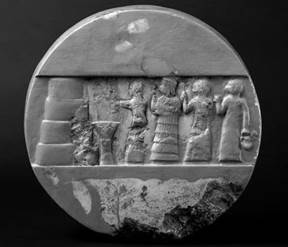
Votive disk of Enheduanna,
from Ur (modern Tell Muqayyar), Iraq, ca. 2300-2275 BC;
Alabaster, diameter 10”; University of Pennsylvania Museum of Archaeology and
Anthropology, Philadelphia
Women of gifted intelligence
often pursued intellectual careers. Female poets were recorded in all
civilizations covered in this book. In Sumer, in particular, all love poetry
was written in a feminine dialect called emesal, which presumably imitated
the high-pitched voice associated with females. Female poets and composers of
religious hymns likely played a role in its development. Enheduanna
(2285-2250 BE), the daughter of King Sargon of Akkad, who was appointed head
priestess of the Moon god Nanna (Sin) at Ur, composed ritual hymns, including
the Exaltation of Inanna, that were recited for centuries. She left
behind a corpus of literary works that are regarded today as one of the first
attempts at a systematic theology. When we examine neighboring traditional
civilizations, similar examples arise. In ancient India, for example, aristocratic
females studied and wrote history, composed verse, taught mathematics, served
as Jainist nuns and disciples, and instructed
initiates in the Vedic mantras. Likewise, during the Han Dynasty of China two
of the most renowned historians were Ban Zh’ao (Pan Ch’ao, AD 45-116) – whose brothers included a famous
historian, Ban Gu (32-92 AD), and a famous general,
Ban Zhao (Pan Chao), to be mentioned in a later chapter -- and Liu Xiang (79-8 BC) who wrote
biographies of 125 important Chinese women.
Both women arose from highly
placed families in Chinese society. Female intellectuals, such as Enheduanna, Ban Zh’ao, and Liu
Xiang, would appear to have been exceptions, particularly since there is little
evidence of recursive institutions in ancient society specifically intended to
insure the flow of female intellectuals over time. Typically, these women had
to sacrifice the more typical expectations of their aristocratic upbringing to
pursue intellectual careers. It is interesting to note, for example, that the
most celebrated treatise written by Ban Zh’ao, Admonitions for Women, expressly
reinforced the construct of female subordination to males furnished above.
Significantly greater status
was accorded female members of ancient monarchies and imperial families, but
this was offset by the tendency among these elites to employ polygamy or royal
harems for political and diplomatic purposes. Not only was polygamy commonplace
in royal households throughout the ancient world, but in addition to wives,
kings tended to acquire numerous concubines, reportedly dozens, if not one for
every day of the year, as symbols of royal wealth. King Solomon of Israel (ca.
970-931 BC) allegedly had 700 wives and 200 concubines. Allowing for obvious
exaggeration in this instance, the evidence obtained from several Bronze Age
Near Eastern dynasties does indicate a tendency for polygamy on a much smaller
scale. Typically, the number of queens was quite small, two or three, with one
invariably recognized as the main queen and the others typically referred to as
minor wives. Most were native princesses possibly of the same royal family,
many haled from leading aristocratic families of the realm, and still others
were foreign princesses used in this manner for diplomatic purposes. Ramses II
of New Kingdom Egypt (1279 – 1213 BC) had two principal wives; however, he
acquired several additional wives during the course of his 66-year reign and
boasted before his death at having sired more than 100 children (59 daughters,
79 sons). Where polygamy is concerned, the most informative example of any
certainty is that of King Philip II of Macedonia (359-336 BC). Philip married
seven women, all but two of whom were foreign nobles and princesses (Phila and Cleopatra were both Macedonian). As one ancient
source (Athenaeus) observed, “Philip liked to marry a
new wife with each new war he began.”
A queen’s influence was
largely determined by her place within the harem, therefore, and the mother of
the heir apparent typically enjoyed the highest status as the chief queen.
Mesopotamian queens frequently possessed separate palaces, bureaucracies, and
households, sometimes managed by powerful female officials. Several Near
Eastern queens took advantage of the power vacuum created by the demise of
their husbands to act as royal regents, particularly in those instances when
the heir apparent was too young to rule. Precisely how the heir apparent was
determined varied not only according to civilization, but even according to
dynasty, and ultimately depended on personal dynamics within the royal family. For
the best examples, we must extend our search beyond the realm of Babylon, once
again. On at least seven occasions Bronze Age Egyptian queens assumed the
throne on behalf of infant sons, three as kings and four as regents (the reigns
of all but two are disputed). The most noteworthy example, Queen Hatshepsut (1479-1458 BC), assumed the throne during the infancy of her
stepson, Thutmosis III, and continued to rule Egypt
for 21 years, long after her stepson attained adulthood. She employed Pharaonic
titles, wore the male clothes of the king (including the ceremonial beard),
made her daughter Neferure pose as queen, and ordered
that she herself be acknowledged as king by all her officials. As Pharaoh she
organized military raids into Nubia and Palestine and conducted maritime
expeditions to the Horn of Africa. Naqi’a, the mother
of King Esharhaddon of Assyria (681 – 669 BC), furnished another
notable example of queen regent. Following her son’s accession to the throne,
she continued to conduct herself as a co-ruler, dwelling in her own palace,
receiving daily dispatches on religious and military matters and composing
royal dedications. She outlived her son and remained a force to be reckoned
with well into the reign of his successor, Ashurbanipal. Some queens were
forced to engage to violence. According to her own hymns Sargon of Akkad’s
daughter, Enheduanna, was driven from Ur in a
political uprising following the death of her father. With the help of her
brother Rimush she was eventually reinstated. Looking
further abroad, we find an Indian queen named Cleophis
of the Ashvakas taking up arms to resist Alexander
the Great’s invasion of the Indus Valley in 326 BC. After her son fell fighting
at the siege of Massaga, she personally assumed the
defense of her kingdom, reassembled her son’s army, and fought to the death
against the Macedonian invaders. Perhaps the most notorious queen of all
antiquity was Olympias of Macedonia, a princess of neighboring Epirus who
married King Philip II of Macedonia as a teenager and became the mother of
Alexander the Great. Not only was she rumored to have participated in the
assassination of her husband (and to have personally murdered her rival,
Philip’s last wife Cleopatra), but following her son’s death in 323 BC, she competed
for the control of his empire. During the Macedonian wars of succession, she
opposed the authority of Alexander’s generals, assumed command of a personal
army, exploited control of her son’s wife and child in a bid for power, and
paid the ultimate penalty for her ambitions. In the traditional venues of
religion, politics, and warfare, therefore, Mesopotamian queens, princesses,
and aristocratic females and those from other ancient civilizations closely
shadowed those of males. On occasion queens and princesses assumed active roles
in the men’s arena. In virtually every
phase of activity, women born to wealth and high aristocratic status chose
individual paths and pursued careers and activities similar to those of men. As
poets, queens, regents, priestesses, philosophers, historians, and warriors,
women at the top of ancient society tended to leave an indelible mark.
As opposed to royal spouses,
Mesopotamian concubines were typically women of inferior social status who were
selected and cared for by the ruler for personal reasons. Concubines apparently
were commonplace among freeborn property-holding social strata as well. In
Hammurabi’s law code a concubine was viewed legitimately as a wife, though not
of the same rank as a husband’s formally recognized wife. She was usually a
free woman (with a dowry) selected to produce children in the event that the
wife proved incapable. Her children were viewed as legitimate although they
would not necessarily be eligible to acquire inheritance alongside the
husband’s legally recognized children. Royal concubines typically arose from
affairs of the heart, and kings tended to collect them like trophies. One of
the greatest fears, in fact, of a client king was that a daughter taken in
marriage by a great king might end up treated as a concubine. Although the
offspring of such relationships could not expect to be in line for the throne,
it is certain that they participated in the palace hierarchy.
Underclass Women in Hammurabi’s Law Code
Looking more specifically at
Hammurabi’s Law Code, women arising from non-aristocratic, freeborn,
property-holding families tended to enjoy more constrained circumstances in conformance
with prevailing mores. Yet, it is precisely here that the nuances to the
existing constraints on women’s behavior are best illuminated. Hammurabi’s Law
Code carefully unfolds the requirements of marriage, including the need for a
dowry, a purchase price, and the preparation of formal contracts. It likewise
reinforces the expectations of the wife’s subservience to the husband in the
marriage relationship. Divorce proved to be a prevalent feature of female
existence in Babylonia according to the law code. Apart from religious
marriages where taboos sometimes prohibited divorce, marriage was a secular
arrangement. Divorce typically required little more than a letter written by a
husband to his wife to indicate that he was divorcing her and ordering her to
return to her father’s house. Since the wife’s dowry was an original component
of that household, it would naturally have to be returned as well, along with
whatever portion of the family’s assets the wife could demonstrate possession
of. As recorded in the law code, If a man
put away his wife who has not borne him children, he must give her the amount
of the purchase money [as much as he paid her father when he married her], and
the dowry which she brought from the house of her father; then he may put her
away (divorce her) (138). In other
words, divorce was relatively simple, but divorce settlements were complex and
generally required years to resolve. Naturally, in non-amicable divorces the
separating parties would attempt to avoid restitution altogether. This is where
the respectability of the married female came into play. In marriage disputes
much about the outcome was determined by the comportment of the woman in
question. Typical accusations leveled against the wife included adultery,
immodesty, or disrepute. If she were found wanting in any of these areas,
usually through an investigation conducted by the city council, the woman could
necessarily be divorced without recovering her dowry. In one extreme instance a
wife apparently attempted to ruin her husband’s fortune, If a man’s wife, living in his house, has made up her mind to leave
that house, and through extravagance run into debt, have wasted her house, and
neglected her husband, one may proceed judicially against her; if her husband
consent to her divorce, then he may let her go her way. He shall not give her
anything for her divorce. If her husband do not consent to her divorce and take
another wife; the former wife shall remain in the house as a servant (141). In this instance, in other words, the
wife’s negative behavior resulted in her diminution in status from housewife to
household servant. In other instances, however, a wife whose conduct was
unimpeachable could expect to prevail against her husband’s accusations. In the
case of a husband who maliciously accuses his wife of adultery, for example,
the code states, If a man have accused
his own wife, but she has not been caught lying with another man, she shall
swear by the name of God, and then may return to her [father’s] house
(131).
Usually when the accused
party could not be convicted on the basis of material evidence and the
accusation remained unresolved, the outcome would be determined through a trial by ordeal. Being “thrown into the
water” (presumably that of the rapidly flowing Euphrates River at Babylon)
represented one such trial, as it was believed that the accused person’s
survival (and hence his guilt or innocence) would be determined by the gods.
Presumably, most people in antiquity could not swim and if thrown in the water
were not likely to survive. This was particularly true in those instances where
the law code specifically stipulated that the accused party(ies) be bound with rope before being thrown into the water.
Apparently, the gravity of the crime was sufficiently abhorrent. A few external
examples of trial by ordeal do seem to indicate that the punishment had as much
to do with public spectacle and humiliation as it did with forms of judgment.
One tablet found at Mari indicates that wealthier citizens could assign
substitutes for this punishment, such as gangs of household servants. In one
instance where the accused party’s substitutes actually began to drown, the man
reluctantly agreed to sign a contract to rectify the situation rather than to
endure any further loss of life. In Mesopotamia trial by ordeal, thus,
functioned as a principle means to resolve guilt or innocence in those cases
where the facts were unclear. As another example of a Babylonian woman accused
of adultery makes clear, it had the capacity to remove any lingering suspicion,
If the finger have been pointed against a
man’s wife [i.e., if she have been suspected], but she have not been caught
lying with another man, she shall plunger herself into the river for her husband’s
[satisfaction] (132).
The likely reason that this
woman was subjected to trial by ordeal while the one noted earlier was allowed
simply to testify to her innocence under oath probably lay in the
unquestionable reputation of the earlier woman in the public eye. In still
another instance, a wife of impeccable reputation actually refused to
cohabitate any longer with her husband, If
a wife quarrel with her husband, and say, ‘Thou shalt not possess me’; then the
reasons for her prejudices must be examined. If she be without blame, and there
be no fault on her part, but her husband has been tramping around, belittling
her very much; then this woman shall be blameless, she shall take her dowry and
return to the house of her father (142). Naturally, if her reputation was
questionable, she ran the risk of a harsher penalty. If she be not frugal, if she gad about, is extravagant in the house,
belittle her husband, they shall throw that woman into the water (143). In
other words, a woman’s status in Babylonian society was largely determined by
the degree to which she conducted her married life with modesty, dignity, and
industry.
Other articles of the law
code worked to insure the welfare of married women and their children in a
variety of untoward circumstances. These ranged from guarantees of material
support with respect to inheritance disputes to those that arose in the event
of declining health, such as mental illness. If a man take a wife, and sickness attack her, if he then set his face
to take a second one, he may; but he shall not put away his wife, whom disease
has attacked; on the other hand, she shall dwell in the house he has built and
he shall support her as long as she lives (148). The law code made certain,
in other words, that the people whom the king viewed as responsible for the
maintenance of the most fundamental institutions of society (family, property,
morality) found protection under the law. Regardless of whether Hammurabi’s Law
Code functioned as a genuine law code or merely as a testimonial to his
fairness as king, its formulation demonstrates a keen interest in protecting
the rights and resources of women. It also displays an awareness of equity, or
the notion that extenuating circumstances such as those that frequently arise
with crimes of passion warrant careful consideration. Another point that
Hammurabi appears to have wanted to demonstrate by this code was his guarantee
that women who abided by the undeniably subservient position accorded them in
life, and did so with unimpeachable modesty – raising and tending to families,
building and maintaining households, and contributing to the livelihood of
their families through handiwork -- would receive fair treatment from the state
and protection from society at large. Although the law code focused primarily
on the status of females arising from elite urban households, one may presume
that the status of freeborn women who labored in the countryside was more or
less the same.
As noted earlier, the
emergence of urban societies inevitably bred underclasses that included women
among their constituencies. Underclass women found themselves in much harsher
circumstances, enjoyed greater freedom to the extent that they were left to
fend for themselves, but typically were
accorded little to no protection under the law. Urban society imposed a
significant financial burden on families that many were unable to endure,
culminating in a breakdown of the traditional safety net afforded by households
and family networks. Widows, orphans, and impoverished citizens fell through
the cracks in Babylonian society and ended up on the streets, oftentimes
homeless and without means of support. As families failed, their servants and
slaves would suffer similarly, creating a form of urban proletariat that had to
be monitored by authorities, particularly since crime was often commensurate
with destitution. In ancient Mesopotamian cities impoverished unattached women
labored in a variety of ways. They ran bars and taverns, sold produce in the
market places, performed artisan tasks, and engaged in menial labor, such as
milling grain, baking bread, brewing beer, and washing and dying clothes. Not
coincidentally most of these activities entailed services to patrons who were
principally males. At the bottom of society the status of females, slave or
free, hardly mattered because they stood at the mercy of their predicament and
at the risk of physical and sexual abuse. In addition they frequently communed
with criminals, oftentimes through no fault of their own. Regardless, any woman
who engaged in activity in the public environment crossed the rigidly
segregated boundaries of ancient gender relations and in the eyes of the law
abandoned all claim to respectability. All those existing outside the
protection of Mesopotamian patriarchal households lived implicitly in ill
repute. No unattached laboring women was afforded legal protection from
physical abuse, and in the case of female laboring in public establishments
such as taverns and inns, it was generally assumed by the authorities that they
also free-lanced as sex laborers. As the law code demonstrates, taverns and
inns and the women who worked in them incurred unsavory reputations. If conspirators assemble in the house of a
tavern-keeper [woman wine-seller], who are not captured and delivered to the
court, that tavern-keeper shall be put to death (109). Women working in
other menial establishments were subjected to similar physical abuse by their
masters, employers, and patrons. In such an environment and under such
circumstances, marriage and family were inconceivable depending as they did on
nonexistent foundations of dowry, bride-price, household, and the property
necessary to support a family.
Even
at the bottom of society social stratification becomes observable. Underclass
women blessed with enormous talent, attractiveness, and energy could sometimes
rise above their station to become public figures as actors, mimes, and
dancers, not to mention, professional high-priced sex laborers known as
courtesans. Courtesans usually rose from slave or non-native origins to be
raised by pimps, the latter of whom invested in their potential as
entertainers. Courtesans typically offered their sexual favors for a price, but
to describe them narrowly as prostitutes diminishes their true capacities. They
worked primarily as entertainers and performers. Courtesans sang, danced,
recited poetry, and acted out scenes of famous tragedies, perhaps at first as
dinner theater in a neighborhood bar or tavern, but eventually in public
festivals or by invitation to royal courts. In other words, their abilities and
celebrity as performers sometimes obtained courtesans access to the highest
levels of society, particularly since the wealthiest elements of society were
invariably the ones most able to afford their services. We will discuss this in
greater detail in a later chapter. For now it suffices to recognize that
courtesans existed in all ancient societies, that their talents made them
attractive to men at the highest levels of society, that they frequently
offered their services as paid companions to kings and aristocrats, and that
they represented the most visible avenue by which women at the bottom of
society could rise above their station to mingle with the urban elite. Despite
their being branded as social outcasts, the potential competition these women
posed to respectable married females at all levels of society forms one of the
salient contradictions to ancient social mores.
Conclusion
From
royalty to slavery Hammurabi’s Law Code demonstrates rigid status orientation
in Bronze Age Mesopotamian culture. However, along the margins of each
gradation the nuances of an ongoing process of blending and variation points to
a society in a dynamic state of development. Large household combines of the
Early Bronze Age gradually yielded place to more privatized collectives,
including the development of stored wealth by individuals, the activities of
independent merchants and traders in long-distance trade, and the advancement
of professionals in a variety of trades. In many ways the social constructs
that would more or less dominate the urban landscape of various later
civilizations were already functioning in Middle Bronze Age Babylon.