Classical
Chinese Civilization
SIDEBAR
Chronology
Of Classical Chinese Dynasties
Hsia
Kingdom (Legendary) 1994-1523
B.C.
Shang
Dynasty 1523-1028
B.C.
Chou
(Zhou) Dynasty 1027-221
B.C.
Chi’in (Qin) Dynasty 221-202 B.C.
Han
Dynasty 202
B.C.–220 A.D.
Three
Kingdoms 220
A.D.–265 A.D.
Six
Dynasties 265
A.D.–589 A.D.
****************************************************
Overview
The history of Ancient
China runs parallel to that of the rest of the Classical world system.
Early hominids arrived in the region by 800000 BP; Paleolithic habitation has
been recorded by 50000 BP; and numerous Neolithic settlements are on record by
8000 BC.
Environment
The
Great plain of northern
Further
south, much like southern
To
the west, the agricultural plains of
The
early history of
***********************
SIDEBAR:
ORACLE BONES
Day
Gui Si divined:
Ke inquired: no ill fortune
during the Xun (the 10 day week)?
The
king prognosticated and said: there will be bad fortune. There will be trouble
that will be inflicted, arriving 3 times.
5
days later, trouble was indeed inflicted from the west. Zhi
Mu stated that Tu Fang reached the eastern border
region and inflicted casualties on 2 towns. Gong Fang also came to graze in our
fields in the western border region.
***************************
This
archaic script employed a combination of characters that was both pictographic
and logographic, that is, symbols used to designate actual spoken
sounds. By the late Bronze Age some 2000 characters were in use. This script
gradually evolved to form the foundation of modern Chinese writing. Aspects of
the proto-Chinese script appear to have emerged from the process of
prognostication itself as well as from the belief that oracular activities
enabled the king (and others) to communicate with deceased ancestors.
Unlike
urban settlement patterns in the West, in Bronze Age China settlements were
organized according to urban clusters, elite
enclosures (fortified precincts) surrounded by a scattering of workshops and
artisan villages. The remains of the enclosures demonstrated that they were
constructed typically of pounded earth through the use of wood framing. At the
excavated remains of the Shang capital at
The
Chinese textual tradition maintains that the Xia dynasty was deposed by the
Shang family (1523-1028 BC). For the Shang we are much better informed, not
only by surviving historical texts, but by the recovery of more than 100,000
inscribed oracle bones at the capital of
All
three of the dynasties Xia, Shang, and Zhou succeeded one another without
evidence of cultural interruption or external interference. Each dynasty most
probably overthrew its predecessor by military means, something historically
confirmed in the case of the Zhou. Having ejected the Shang, the Zhou (1027 to
221 B.C., headquartered in
The
power and legitimacy of the Zhou were weakened gradually by their inability to
confront mounting raids by Turkic and Mongolian marauders from the north.
Roving bands of horse-mounted warriors repeatedly pillaged and plundered the
settlements of exposed feudal states. The burden of incessant warfare forced
the Zhou emperors to impose higher demands on their vassals for military
manpower and supplies, even as their legitimacy waned. In 771 BC an alliance of
overburdened feudal lords attacked the Zhou emperor at his capital, sacking the
city and killing the king. One prince of the realm managed to escape eastward
to Loyang to reconstitute the dynasty, hereafter known as the Eastern Zhou
Dynasty. However, the Eastern Zhou lacked substantial territory from which to
rebuild their empire and were obliged to accept status as token figureheads. In
essence, the kings of the Eastern Zhou Dynasty remained sanctified overlords
whose primary role was to perform the imperial sacrifices to insure the
necessary equilibrium between heaven and earth. This left the former vassal
states free to develop on their own initiative, typically at the expense of
neighboring states. Internecine warfare became the order of the day. During
this era known as the Spring and Autumn period
(771-481 BC) as well as during the subsequent, significantly more violent era
of the Warring States (480-222 BC), a number of diametrically opposed phenomena
occurred. Power bases became solidified at the regional level as the number of
existing states was gradually reduced by civil wars from approximately 1000 in
1026 BC to 100 in 771, from 100 to 14 by 480 BC, and from 14 to 1 by 226 BC.
Despite the rising threshold of violence, the population of the surviving
states actually grew in size not only through the incorporation of neighboring
territories but also through the intensification of agricultural production and
the expansion of territory into non-Chinese lands to the north, south and west.
Along the northern hills of the Yellow River, for example, local dynasts
employed various strategies such as tax exemptions, land sales, and land
allotments to settle colonists in forests and grazing lands previously occupied
by non-Chinese nomads. This process disrupted the equilibrium of neighboring
nomad society while expanding the base of agricultural terrain through land
clearance. Recent scholars have observed that the expansion of Chinese
territory into nomad territories actually compelled neighboring pastoralists to
forge larger, stronger confederacies whose growth progressed at roughly the
same pace as that of Chinese state formation. By the time of the Ch’in dynasty
(226-202 BC), these amalgamated confederacies were dominated by the emperor (shanyu) and
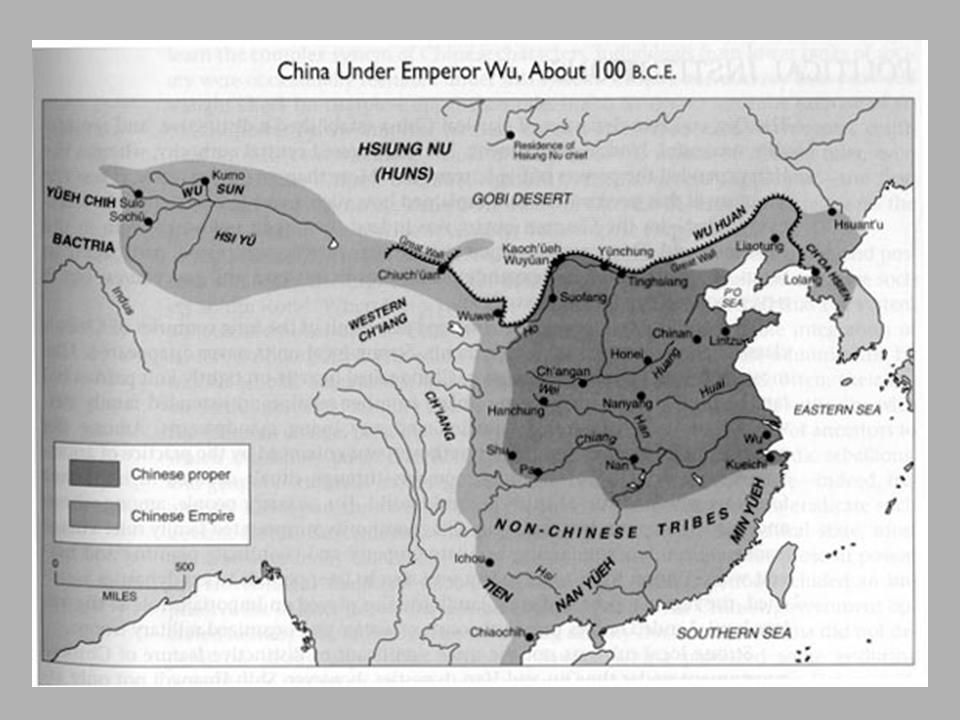
supreme council of the Hsiung Nu (Huns). As Hsiung Nu raiding along the borders of the Chinese states
accelerated, the exposed principalities responded by constructing extensive
perimeters of earthen barriers along the newly claimed frontiers. These
defenses would eventually develop into the Great Wall of the Ch’in and Han
dynasties. The chief purpose of the walls was to reduce points of access of
mounted bands of Hsiung Nu warriors to more
defensible areas and thereby restrict their mobility, limit reinforcements, and
prohibit random escape. Along the western highlands of the Yellow River, Hunnic
elements defeated by Chinese rulers were frequently settled inside the walls by
Chinese warlords to complement their armies with skilled cavalry contingents.
This furnished polities such as the Ch’in of Shensi with a decided tactical
advantage throughout Chinese history, even as it lent them dubious reputations
as semi-barbarous states. The historical record demonstrates that non-Chinese
pastoralists quickly assimilated mainstream culture to become indistinguishable
from native Chinese.
The
rising emphasis on mounted warfare created equally high demand for war horses.
Horses achieved nearly mythical status in Chinese lore. Horse trading and horse
breeding became crucial to Chinese military expansion; particularly in demand
were imported horses from the far western steppes of Central Asia that were known
to be larger, stronger, and allegedly sweated blood. To combat the tactical
advantage of cavalry, meanwhile, rival polities abandoned obsolete forms of
aristocratic chariot warfare in favor of large formations of infantry armed
with powerful crossbows (another Chinese invention), increasingly mobilized
from local peasantry. The need to furnish large armies with armor and weaponry
placed heightened demand on mining and metallurgy, particularly in the eastern
states where iron ore was accessible by sea from mountainous regions to the
south. Once introduced Chinese iron smelting achieved higher levels of
proficiency than it did in the West. By inventing technologies such as
hand-pumped bellows and charcoal produced from coal, the Chinese were able to
achieve the high firing temperatures necessary to produce carbonized steel. The
deadly combination of Hunnic cavalry formations and heavily armed mass infantry
inevitably revolutionized Chinese warfare and made the outcome of feudal
confrontations irreversible.
The
political and social instability that accompanied the ineffectual leadership of
the Zhou thus set in motion a number of changes. As accelerated warfare
displaced local dynasties and their hierarchies, leadership cadres abandoned
the old ways of feudal society in favor of new forms of employment. Scholars
and former officials with skills acquired through service with unsuccessful
feudal states migrated through
Classical Chinese
Philosophies
Confucianism
According to tradition Confucius or Kung Fu Tzu
(551-479 BC) was precisely one such example of a displaced learned official.
Raised and educated in the feudal state of Lu (modern
Confucius’
teachings furnished a code for the newly emerging Chinese “gentry-based” ruling class. Much
like Buddhism, Confucius did not challenge the essentials of the traditional
Chinese religious world view, but offered instead instruction for the conduct
of mortal life on earth. In many ways he was a traditionalist, committed to
Shang era beliefs in the ancestor cult and the Mandate of Heaven. He insisted,
however, that the heavenly god T’ien should not be
regarded so much as the arbitrary king of the heavens as he should the
embodiment of a universal system of order and legality, the so-called principle
of tao.
Humans needed likewise to conduct their earthly affairs in accordance with Tao.
To insure the safety of the Chinese people, for example, the emperor needed
faithfully to observe the established ceremonies and to offer prescribed
sacrifices in accordance with the law. Lesser individuals likewise needed to
conduct their lives in such a way that harmony was preserved between the cosmic
order and human society. This harmony presupposed the subordination of the
individual to the community according to clearly defined principles of rank. In
Confucian philosophy everyone in society had a defined place in the social order that was
referenced by its superiority and/or subservience to related members of society.
The status of each individual carried with it an obligation to maintain the
social fabric through proper behavior. According to this philosophy rank was
ordered according to Five Confucian relationships:
Ø Ruler to Subject
Ø Husband to Wife
Ø Parent to Child
Ø Older Sibling to Younger
Sibling
Ø Friend to Friend
The
five relations displayed two fundamental assumptions about Chinese social
relations, namely, that no two persons were equal and that inequality was
expressed according to three basic criteria, age, gender, and social rank. At the core of Confucianism
stood the individual. “It is man that can make Tao great,” Confucius observed.
Although Confucius taught numerous virtues, his cardinal virtue was jen, which is
variously translated as humanity, love, or human kindness. To Confucius, jen was simply jen,
another word for the individual. It defined the very essence of the virtuous
person. Significantly the Chinese character for the word consisted of two
parts, one representing the individual and the other human relations or
society. The ideal virtue, therefore, involved both the perfect individual and
the perfect society. This was the goal not only of Confucianism but of all
Chinese philosophy.
For
Confucius the ideal citizen was the superior individual, or the chun-tzu, literally, the son of a ruler. Until the
era of the Warring States, the chun-tzu was
plainly an aristocrat; however, to Confucius the superior individual achieved jen not through blood lines but through moral excellence.
Such a person was wise, benevolent, and courageous; he was motivated by
righteousness instead of by profit. He studied the Way, Tao, and loved
humanity. Confucianism thus emphasized a code of human behavior. He left
unanswered the question whether by nature humans were inherently good. "By
nature humans are alike," he said, "but through practice they become
different." Confucius proposed that China be governed by a new class of
“virtuous men,” enlightened individuals who selflessly devoted their energies
to the maintenance of the social order and the welfare of the people.
Self-perfection, family harmony, social order, and world peace could all be
attained so long as balance and harmony were achieved between the individual
and society. Only in such a state could Tao, the moral law of the universe
rooted in the Mandate of Heaven, prevail. As Confucius insisted, “Without
knowing the Mandate of Heaven one could not become a superior man.”
Confucianism therefore summed up both the complaints and the aspirations of the
emerging “gentry” class that would govern Han-era China. The new elite that
replaced the feudal aristocracies of the Warring States were educated in
Confucian schools and knew the requirements of literacy, courtesy, and refined
behavior. Around 100 BC officials working under the imperial Han dynasty
initiated a system of state examinations to recruit future officials like
themselves from students educated in the Five Chinese Classics. While in
practice state officials tended to be recruited from within the gentry class
itself, in theory Han dynasty officialdom became accessible to any educated,
respectful, well bred citizen. The consequence of the Confucian system of
regularized education and examination was to produce a
sustained, educated elite to govern over the uneducated agricultural
masses. These leaders tended to be “generalists” rather than specialists,
“gentlemen,” rather than “professionals.” There is no denying, however, that
when extended across the breadth of the Chinese society, this system enabled
the ruling class to withstand crises and political and social turmoil by
replenishing and reconstituting itself time and again with talented leadership
cadres. The kings of the Han Dynasty likewise embraced Confucianism because it
provided them with theoretical justification for their own authority and served
as a useful means to maintain order. Confucian notions of “enlightenment,” of
devotion to public service, and of proactive participation in and maintenance
of the social order bore obvious similarities to Stoicism in the Greco-Roman
World.
Taoism
In
the same manner that Epicureanism challenged Stoic philosophy in the West, Taoism framed a popular response to Confucianism in
China. According to tradition Taoism was articulated by an elder contemporary
of Confucius, named Lao-Tzu (now dated c. 350 BC), but in accordance with the
tenets of the philosophy itself, it evolved and matured anonymously through the
work of numerous intellectuals, simply known as the “masters.” Like Epicureanism
Taoism expressed a sense of futility in so far as the efforts of humankind to
improve the natural order were concerned. Even though Taoists denounced
conventional morality, they cherished love, wisdom, peace, and harmony no less
than the Confucianists. Unlike Confucianism, however, their Tao was
not the Way of humans but the Way of nature. According to Lao-Tzu, Tao was the
standard of all things to which all humans must conform. Tao was eternal,
absolute, and existed beyond space and time; in its operation it was
spontaneous, everywhere, constant and unceasing, always in transformation,
progressively proceeding through cycles before finally returning to its root.
At the core of this philosophy was the duality of opposites, Yin and Yang, male
and female, light and darkness, Being and Nonbeing, revolving in a state of
perpetual dynamic. According to Lao Tzu, all things carried the Yin and
embraced the Yang. Through the blending of their opposite material forces Yin
and Yang achieved harmony. The Yin-Yang ideal dictated that in marriage there
should be the harmony of the male and the female; in landscape painting that of
mountain and water; and in spiritual life, that of humanity and wisdom. It was
futile for humans to attempt to oppose nature, to improve it, or to overcome
it. Much like the Epicureans, the principal objective of the Taoist was to
become a sage, or a person of “sageliness within and
kingliness without.” Also like Epicureanism, Taoist “sageliness”
demanded withdrawal from society and the abandonment of political ambition for
a life devoted to the contemplation of Tao. This was more than a metaphysical argument; passivity, frugality, and
simplicity were the necessary prerequisites of enlightened behavior. It was
only through the realization that everything pursued its own independent course
and yet came around to form one harmonious whole that happiness and freedom
could be attained.
Confucianism
and Taoism became countervailing philosophical schools as China emerged into
empire. They survived from an era of “One Hundred Schools of Thought,” in
part because their proponents successfully incorporated the tenets of competing
philosophies over time. Taoism enjoyed many attributes in common with Buddhism,
particularly its doctrine of renunciation of the material world. This opened
the way for the transmission of that particular world view to China. Taoism’s
oppositional character to the formalistic, increasingly aloof culture of
Confucianism also made it increasingly popular with the masses. By the time of
the later Han Dynasty (AD 9-202), Taoism absorbed aspects of popular mysticism,
shamanism, and witchcraft. Alchemy and medicine became Taoist stock in trade,
along with promises of immortality and rebirth. By the close of the Classical
era the Seven Sages of the Bamboo Grove were ridiculed as drunkards and
eccentrics. According to a contemporary source, the Seven Sages “all revered
and exalted the entities of Non-Being and Non-Action and disregarded the rites
and law. They drank wine to excess and disdained the affairs of this world.”
One sage, Liu Ling used to declare that to a drunken man the “affairs of the
world appear as so much duckweed in a river.” Notoriously he rode about the
capital city in a small cart drawn by a deer, accompanied by a servant bearing
a large pot of wine. However, these critics failed to recognize that through
their eccentric, drunken behavior the Taoists were expressing a deliberate
protest against the formality, ritualism, and elitism employed by Confucian scholars to distance
themselves from everyday society.
Legalism, the third major intellectual
development of the era of the Warring States, was not strictly a philosophic
school at all. In fact, this school of thought rejected all philosophic
disputation, Confucian or Taoist, as futile and baneful to the interests of the
state. To philosophers such as Hsun Tzu (Xunzi, c. 250 BC), humans were inherently evil, corrupt,
rebellious, disorderly, and undisciplined. The job of the king and his
officials was to steer the flawed masses to correct behavior through the use of
codified law, main force, and examples of severe punishment. Like Confucianism
Legalism emerged with unemployed upper class elements who peddled their
knowledge and political experience to competing Chinese warlords toward the end
of the Era of the Warring States.
However, the Legalists abandoned faith in the moral tenets of Confucianism and
made their peace with the new social order. Legalists insisted on the exclusive
authority of the ruler and his ministers. The power of the emperor was
restricted only by his responsibility toward s heaven. The ruler should have
little to do with the day to day affairs of government. His job was to perform
the numerous, complicated rituals that maintained the Mandate with Heaven. This
also meant that he had to follow and enforce basic rules of morality to prevent
the repeal of his mandate as might be indicated by ominous oracular signs. The
king’s chancellery represented the engine of the imperial will; its purpose was
to draft measures to propel the Chinese people on its course. Progressively
codified into law, these strictures were applied equally to elements at all
levels of society. By 200 AD the Han Dynasty penal code grew to 26,272
paragraphs in 960 volumes. Beneath the court administrators everyone else was
viewed as a commoner. The people’s primary duty was to live and work for the
ruler and to obey without question the orders emanating from his chancellery.
Infused by Legalism, the ministries of Ch’in and Han Dynasty China exerted
absolute control over their subjects. In the proper hands, this totalitarian
authority could achieve massive public undertakings and galvanize the Chinese
state to withstand crises; in the wrong hands it amounted to raw, arbitrary
tyranny. Not surprisingly, legalism was first adopted by the rulers of the
western principality of Ch’in, where non-Chinese influences were pronounced. It
left its most profound impact in the historical record of beheadings, the
ultimate punishment impose not only on murderers and thieves, but on ministers,
generals, and even chancellors accused of malfeasance and treason against the
realm. Beheadings form a recurring backdrop to the narrative of the Han
Dynasty, leading one to believe that the dispensation of capital punishment was
swift, capricious, and arbitrary. No one in Chinese society was so lofty as to
assume that he could escape the penalty of death for capital crimes. Even
China’s greatest historian, Ssu-ma Ch’ien, (Sima Qian, ca. 100 BC)
was forced to submit to the penalty of castration when accused of deceiving the
throne. The argument used to justify this phenomenon reasoned that the Han
emperors were bound by the law code of the legalists every bit as much as their
subjects. As the adopted sons of heaven, the emperors were obliged to follow
and to enforce basic rules of morality; failure to punish malefactors could
result in the withdrawal of heaven’s mandate. As the representatives of
heavenly justice, therefore, the emperors had a religious obligation to inflict
severe punishments on criminals and thereby prevent the disruption of the
harmony between heaven and humankind. As one Legalist commented, “Anciently the
Sage Kings knew that man’s nature was evil, partial, bent on evil, corrupt,
rebellious, disorderly, and without good government. Hence they established the
authority of the king to govern man; they set forth clearly the Li (ritual or code of morality) and
justice to reform him; they established laws and government to rule him; they
made punishments severe to warn him, and so they caused the whole country to
come to a state of good government and prosperity.” Therein lay one of the
inherent contradictions of Chinese society. Imperial China became a state based
on the rule of moral authority; it came to value learning above birth or
wealth; it administered an empire with a bureaucracy composed of dedicated,
highly educated officials. On the other hand, it imposed a legal system that
employed fear as its primary deterrent, one that exacted punishments of cruel
and barbarous severity. Confucian ideals of justice and benevolence may have
been prominent in the theory of government, but it was absent in its legal
tribunals.
The Ch'in Dynasty (221-202 B.C.) rose from one of the many competing feudal
dynasties of the Warring States era. Situated in the western Shensi (Shaanxi), “ the land between the two passes,” Ch’in was more
practicably defensible than its rival states in the east; it was also more
heavily exposed to nomadic influences. Early leaders of the state recruited Hsiung Nu cavalry contingents and mobilized the entire
peasantry into the army. Ch’in Shih Huangdi ('first emperor'), the ruler from
which the dynasty receives its name, was able to establish dominance by force
of arms and after conquering all surviving feudal principalities assumed the
title, Huangdi,
“supreme ruler.” Formerly used exclusively to refer to legendary, semi-divine
heroes, Ch’in’s assumption of this title furnishes one of several indicators of
his megalomania. Another survives in the form of his burial memorial, a massive
tumulus surrounded on all sides by interred formations of more than 7500
life size terracotta statues of warriors. Arranged in battle
formation the statues were apparently intended to guard him in the afterlife
and were crafted and erected at considerable public cost. Remarkably, the face
of each terracotta warrior is unique, indicating that artists sketched
representative members (if not each and every member) of his army before
molding the statues. Ch’in’s terracotta army, perhaps only a fraction of which
has thus far been revealed, ranks today among the archaeological wonders of the
world. Everything else about Ch’in suggests that he was cruel and ruthless
tyrant, determined to exploit the full laboring potential of the Chinese
population in pursuit of his grandiose scheme for world domination. By relying
on brute force and cold administrative efficiency, Ch’in successfully transformed China from a cluster of squabbling feudal
states into a unified bureaucratic empire. Although Ch’in’s dynasty did
not survive his death, it left an enduring legacy to
As
noted above, Ch’in’s regent had been a
successful if ordinary merchant, and he otherwise surrounded himself with
foreign generals of nomadic background and revolutionary ministers and
officials of legalistic mindset. These in turn conferred patronage on equally
minded recruits from the displaced educated elements of the Warring States. A
great military organizer, Ch’in successfully crushed the remaining feudal
states of his generation and eradicated their leadership by forcibly evacuating
the defeated noble families to his capital, Hsien Yang (Xianyang)
in Shensi (Shaanxi). Allegedly some 120,000 families of the aristocracy were
transported to
In
place of the feudal aristocracy the Ch’in’s administration dispatched military
officers to the defeated eastern states to rule them as conquered terrain. Now
devoid of aristocratic leadership, the tax-burdened rural peasantry rose
repeatedly in rebellion and had to be forcibly suppressed. Once effectively in
control, Ch’in’s ministers devised a uniform system of administration that
divided the newly assembled realm into provinces, with the provinces themselves
divided further into prefectures. Newly conquered non-Chinese territories were
similarly organized into commanderies with military
governors. This enabled officials dispatched from the central administration to
monitor activities all the way to the “grass roots” level. Ultimately, the
Ch’in Dynasty adopted a system similar to that of the Achaemenid
Dynasty of Persia, with civil and military governors assigned to overlapping
fiscal and military jurisdictions in the same provinces, and with the affairs
of each subject to the scrutiny of a third comptroller dispatched by the
emperor himself. The balance of power achieved between these three officials
prevented any one of them from organizing a powerbase capable of threatening
central authority. The usefulness of this system of “checks
and balances” was recognized by the Han and later dynasties who perpetuated its
use. Having more or less secured control of the countryside and its
resources, the Ch’in administration next set to work on massive public works
programs, ostensibly in the interest of Chinese society as a whole. As noted above, in 214 BC Ch’in’s
administration set to work rebuilding the system of the fortification walls
that had previously been constructed piecemeal by various warring states in the
north. When finished the refurbished and reorganized 5,000-kilometer-long Great
Wall extended all the way from Manchuria in the east to Tun
Huang in the west. [In its present state, the Great Wall was
rebuilt under the Ming dynasty between 1368 to 1644 AD.] This last
mentioned garrison town served as the military headquarters of the general
assigned to the “Protectorate of the Western Regions” and guarded the passes that led to the Tarim Basin. The construction of the Great Wall not only
combated the rising nomad threat to the north, it also positioned Chinese
military forces to investigate, and if necessary to conquer distant trading
centers to the west. Hundreds of thousands of laborers and convicted criminals
were forcibly conscripted and dispatched to the remote and dangerous “Western
Regions” to build and defend these walls. Folk ballads that were still sung in
modern times record the lament of everyday people
forcibly separated from their village homes and families, never to return.
Other public works closer to home, such as the dredging of new canals on the
great rivers, the design of connecting road networks, the construction of new
administrative centers in the prefectures, and not least, the building of the
tomb and palace of Ch’in himself in Hsien Yang, were likewise initiated as
laboring projects for the regime’s mounting population of “criminals.” Arguably
a military genius, the emperor’s innate megalomania left him increasingly
vulnerable to magic and superstition. His palace was constructed according to
various astronomical and magical principles; his tomb was laid out in
accordance with the cosmological map of the universe. He ceaselessly indulged
magicians who promised him means to immortality. Convinced by reports of the
existence of a distant overseas island where the inhabitants were immortal, he
commissioned a naval expedition to set sail in search of it (like the thousands
of laborers dispatched to the Great Wall, these sailors never returned).
Driven
paranoid by the breadth of his unpopularity, Ch’in lived and worked in closely
guarded secrecy. Knowledge of his everyday movements in the vast palaces at
Hsien Yang was restricted to a handful of trusted eunuchs. When he died while journeying
in the eastern provinces in 207 BC, the hundreds of soldiers and officials that
attend his imperial cortege marched across the entire length of China to Hsien
Yang completely unaware of his demise. His accompanying minister went so far as
to place a cart of rotting fish directly behind the emperor’s wagon to throw
people “off the scent.” Heavy handed tyranny, mounting requisitions, incessant
warfare along the frontiers, and the brutal repression of a restive population
eliminated any likelihood that his dynasty could survive. On the news of his
death, the empire was wracked by uprisings in every quarter. The government
endured a sequence of rebellions; six pretenders to the throne were eliminated
in rapid succession. After several years of chaos the general Liu Chi
successfully removed the nominal head of the Ch’in dynasty. Assuming the
imperial name Kao Tsu, Liu Chi founded the Han dynasty (202 B.C. to 220 A.D) and successfully restored political
stability in China.
The Han Dynasty (202 B.C. to
220 A.D)
The Han dynasty took its name from the river that
flowed through the dynasty’s domains in Szechuan and southern Shensi. Its
capital was located in Ch’ang An. Kao Tsu’s first task was to determine a way to reassemble the
tattered state that the Ch’in had left behind. Kao Tsu
had risen from the ranks as a military officer and had attained power by
assembling around him a cadre of similarly rebellious warlords. To reward them
for their support he assigned them territories as new artificially created feudal
states. He also restored some of the ancient feudal kingdoms, though in much
diminished size. This placated his two most difficult constituencies and
convinced them to accept his authority. Once secured with the Mandate of Heaven
as emperor, he made certain that succession to the imperial throne would remain
restricted to members of his own family. In the countryside he maintained the the Ch’in governing system of provinces, commanderies, and prefectures and selected hand-picked
officials to rule. Although posing as a traditionalist, Kao Tsu
allowed this dual tiered governing system to pursue its natural course.
Inevitably the smooth efficiency of the central administrative out paced the
poorly organized, decentralized governments of the feudal states. Kao Tsu and his successors kept a tight reign on the feudal
kings by summoning them repeatedly to court and by ordering them to be removed
(and beheaded) at the slightest provocation. Even the generals who had helped
Kao Tzu’s rise to power were summarily executed for real or alleged
conspiracies. As the Han administration grew more confident of its authority,
it imposed additional laws to weaken the dynasties of the feudal states. For
example, a decree of 144 BC mandated that inheritance within feudal states must
be divided equally among all sons of a feudal king. This guaranteed that vassal
principalities would gradually diminish in size even as they multiplied in
number. In the event that a feudal line failed to produce an heir, the kingdom
was summarily absorbed into the Han provincial administration. Generation by
generation, the feudal states dwindled in stature. When Kao Tsu
first established the system some 143 feudal fiefs were recognized by the
emperor; by the end of the Han dynasty some 241 feudal states existed on a much
reduced scale. Typically their size was reduced to a radius of two or three
communities. The provincial territories of the Han greatly eclipsed those of
the surviving feudal houses.
In
place of the aristocracy, the Han turned to the leadership of Confucian
scholars recruited from the emerging gentry class.
Like the nobility the gentry class relied on lineage
groups to provide security in turbulent times. Gentry
clans relied on subordinate branches of the family to maintain control of
agricultural terrain at the local level. Members of the principal branch,
meanwhile, received the necessary education to pursue political affairs at the
capital. Rank within the family lines determined one’s place in the network,
just as education in the Chinese “Classics” determined one’s eligibility for
government service. Some gentry clans claimed descent
from ancient families, but this was no longer a prerequisite. Most gentry families were newly arisen from careers in
officialdom, trade, and warfare. All gentry families sustained themselves on
landed estates that they leased to tenants. Subordinate branches of the family
normally lived in countryside and supervise the agricultural work. In many
instances they served as tax collectors and thus extended the scrutiny of the
imperial bureaucracy over the local agricultural population. Subordinate
branches of the gentry clan combined resources to
assist the politicians of the senior branch with their official careers. The
politicians typically forged political marriages and engaged in political
combines at various levels of the bureaucracy to further their careers and to
obtain benefits that they shared with their wider families. If a family
politician fell out of favor at the court or was convicted or even executed for
an alleged crime, the entire lineage group would inevitably bear the impact.
Within a generation or two, however, the family would invariably rebound with a
new crop of educated politicians. As a result, gentry families remained
relatively secure in their wealth and status.
Han Dynasty
To
recruit gentry scholars into the government, the Han
rulers successfully promoted principles of Confucianism as tenets of the
regime. Naturally they emphasized first and foremost the Confucian relationship
of the subject’s obedience to the king. Implementation of the state examination
process guaranteed a steady stream of Confucian Chun tzu or educated gentlemen into the
cadres of the imperial bureaucracy. The Han kings surrounded themselves with an
array of court officials, including three imperial counselors, nine ministers
of state, eight generals, and scores of palace attendants. Following the Ch’in
model, the secretariat of the court chancellor imposed inspectors throughout
the ministries and various branches of the provincial administration to insure
accountability at the periphery. The
large distances from the court in Ch’ang An naturally restricted the ability of the central
administration to control affairs in the provinces. Local officials in the commanderies, for example, enjoyed relatively wide latitude
to govern on their own, though they could be summoned to the palace at the slightest
hint of disloyalty. Similar distinctions emerged between civilian and military
sectors of the government. Since statistics were crucial to central planning,
officials at the local level worked diligently to collect and to transmit
accurate information to their superiors. As a result surviving Chinese records
furnish detailed, fairly reliable census figures, not only for the provinces of
China but even for the non-Chinese people in distant protectorates. In 1 AD,
for example, the census recorded 12,400,000 households and 57,000,000
inhabitants in the Han empire.
During
times of war eight supreme generals were commissioned to mobilize the imperial
army. These generals assumed authority over all forces furnished by the
provinces, the feudal principalities, the foreign protectorates, and even the
imperial palace guards. Throughout the era of the early Han Dynasty (202 BC - 6
AD) the main focus of the Chinese military establishment was the incessant
confrontation with the Hsiung Nu empire to the north
(estimated at 2 million in population). Considerable debate raged at the court
regarding the most suitable policy for dealing with the Hsiung
Nu. One faction argued for a policy of offensive operations that requiring the
undertaking of extremely costly and dangerous campaigns in the remote and
inhospitable regions of the Hsiung Nu. Another
faction argued in favor of appeasement on the assumption that an effective
combination of diplomatic engagement (including treaties and arranged marriages
between Chinese Han princesses and the kings of the Hsiung
Nu) and “gifts” (typically in the form of foodstuffs and tens of thousands of
bolts of valuable silk) would gradually inure the leadership of the Hsiung Nu to the benefits of good relations with the Han,
based in part on material dependency. Through the repeated employment of
“gifts”, marriages, and treaties, however, it became increasingly clear to the
Han administration that the shanyu and the ruling council of the Hsiung
Nu exerted little genuine control over the Hunnic warlords on the periphery.
Regardless of the wishes of their distant overlords, the local leaders of this segmentary society raided and plundered Chinese settlements
along the frontiers without scruple. Inevitably, the tide turned in favor of
the militaritsts and a succession of powerful
generals were dispatched to the western and northern
boundaries to confront the Hsiung Nu with force.
After a series of difficult campaigns, several of which ended in disaster, the
Han dynasty succeeded in breaking the unity of the Hsiung
Nu confederacy in 51 BC and purchased itself a brief span of frontier security.
The
logistical support required by these desert and steppe operations point to
another challenge to be overcome by the Han Dynasty, namely, overland transport.
The Han showed remarkable flexibility modulating between the use of incentives
to stimulate private economic initiative and direct intervention in the economy
through the creation of imperial monopolies. Through the construction of
interconnected networks of canals and roads the Han administration was able to
transport grain produced as tribute in the eastern provinces all the way to the
western capital of Ch’ang An and beyond. To encourage
the necessary transport of supplies to the western war zones, the Han offered
incentives such as official rank to those capable of arranging these
activities. With the conquest of territories in the southwest around 100 BC,
the emperor Wu Ti (141-86 BC) actually attempted the seemingly impossible task
of constructing a road network across the rugged, densely forested terrain of
Southeast Asia to India, embarking on the ancient equivalent of the modern
“Burma Road.” The central administration likewise offered incentives to the
poor as well as to criminals to encourage them to serve on the frontiers. When
complaints arose about the manipulation of prices of the essential commodities
of salt and iron, the government intervened to create state monopolies.
Although many of these ventures proved costly, the projection of force
westward, northward, and southward enabled Han dynasty to secure its borders
and to achieve domestic tranquility, while at the same time methodically
gathering reliable information about peoples beyond the imperial horizon. One
particular diplomat, Chang Ch’ien, was sent by the
emperor Wu Ti in 138 BC to negotiate an alliance with a break-away element of
the Hsiung Nu known as the Yueh
Chih. The Yueh Chih had been driven beyond the Pamir Mts.
by their nomadic rivals but had successfully formed a new confederacy in
Central Asia that included the Kushan conquerors of
northern India. Chang Ch’ien pursued his diplomatic
travels as far as the Indus and returned to the court at Ch’ang
An in 133 BC with detailed information about the urban
societies that existed in India, Iran, and beyond, not to mention the exotic
prestige goods that these made available to China. Chang Ch’ien’s
mission helped sway Han policy toward direct intervention in the western region
and culminated in the conquest of the oases states of the Tarim
Basin by the Chinese general Li Kuang-li. In 104 BC
Li Kuang-li mounted an invasion of the lands beyond
the Pamir Mts., marching his army across the Oxus River into Afghanistan. In 97
AD, Pan Chao, a commander of the Later or Eastern Han Dynasty, led a second
Chinese army of 70,000 men across the Pamir Mountains. This army advanced
unopposed all the way to the shores of the Caspian Sea. The significance of
these Chinese expeditions to the formation of the ancient world system will be
discussed in a later chapter. For now it suffices to note that reliable
information about the outside world began to replace the exaggerated accounts
of traders and travelers and placed the Han dynasty on more solid footing in
its dealings with the outside world.
Collapse of the Han Empire
Dissensions
among competing factions of gentry families in the
government eventually exposed the Han Dynasty at its core through destructive
power struggles. On the demise of a given Han emperor the family of his most
powerful wife (the dowager empress) typically attempted to seize power either
by choosing a successor or by replacing the members of the ruling family with
those of the empress’s “consort” family in all important positions of state.
For a span of 20 years during the Eastern Han Dynasty, one particular consort
family, the Liang, generated no less than 6 princes, 3 empresses, 6 imperial
concubines, 3 grand generals, and 57 ministers and provincial governors. After
jockeying for position for decades, elements of the Wang family usurped the
throne in 9 AD, setting in motion a violent civil war that raged between the
Wang and collateral branches of the Han family until 25 AD. By the time that the Han successor, Kuang Wu Ti, restored order, his
capital in Ch’ang An had been
destroyed, forcing him to relocate eastward to Lo Yang in Honan to be closer to
the agricultural heartland. Here the Eastern Han Dynasty managed to survive
until 202 AD. Palace intrigue among the most powerful families continued to
plague the regime, along with munities in the army, and widespread peasant
rebellions such as the rebellion of the Red Eyebrows at the time of the Wang
usurpation and that of the Yellow Turbans in 184 AD. The fury of these mass
uprisings, typically led by charismatic commoners who claimed mystical and
magical abilities, took years to overcome and left everyone in the government
dismayed.
Distracted
by such internal dissensions the Han administration lost its grip on the
frontiers, as well as on the agricultural countryside in the provinces.
Gradually, the cost of maintaining this massive land-based empire became too
burdensome. The collapse of the Han Dynasty in 202 AD ushered in four centuries
of civil war known as the Era of Disunity (220-588 AD). This era was
characterized by repeated attempts of powerful warlords to re-consolidate China
only to result in further chaos. Meanwhile, new confederacies of the Hsiung Nu and the Toba emerged as threats in the northwest
and the northeast respectively. In the fourth century AD these peoples invaded
the Chinese heartland in a decisive manner. They settled along the Yellow River
as overlord populations, destroying settlements and driving many of the elite
families of the gentry southward beyond the Yangtze River to reconstitute
themselves in newly formed kingdoms. Through the development of a unified
culture extended across a vast landmass, the Chinese managed to forge one of
the great world empires of the Classical era, believed by some to have been the
largest civilization of that time. After long periods of violence the Chinese
were able to achieve a sustained period of stability that brought prosperous
urban society to a wide population. Although Chinese society relied on absolute
monarchy to achieve stability, its monarchy based its authority on religious
and philosophical principles of a higher moral order reinforced by a legal code
that was increasingly applicable to all citizens. This furnished an important
deterrent against tyranny and encouraged the participation in the Han regime by
wider elites. Most of all, the empire was governed by a broad class of property
holding families, whose leadership was determined through processes of
education and examination. The intellectual requirements of government rank
insured an essential competency in the imperial administration and fostered a
sense of dedication throughout the bureaucracy. With careful attention to
detail and loyal adherence to the hierarchy the Chinese had managed to overcome
difficulties of distance and topography to assemble a unified empire and to
project force into distant regions. Despite its continental separation from the
other urban civilizations to the west, Classical China made a significant
contribution to the ancient world system.